Saturday, April 28, 2018

A New Pole for Flag Day


The hole was only about a foot deep when the two old ranchers stopped for what Mike referred to as a “Hydration Break.” 

After both of the two old cowboys had retrieved a can of Mexican beer from the cooler resting in the bed of the old Ford pickup, Kent said, “Why don’t you just call it a beer break?”

“The kidney doc told me if’n I didn’t want any more stones, I had to stay hydrated,” replied Mike as he liberally sprinkled salt around the top rim of the beer. 

Reaching for the salt shaker, Kent asked, “Are you sure hydration meant beer?  And what would your cardiologist say about that salt?”

“I’m smart enough not to ask doctors fool questions I don’t want to hear the answers to.  And salt is an honorary vegetable.” 

The two old cowboys went back to trying to dig a hole big enough for the new flagpole.  The work was hindered by the thick gravel and rock that made up most of Chesnut Mountain, where the ranch was located.  The work with the posthole digger was frequently interrupted by the use of a heavy steel pry bar to bust up the rocks.

“Tell me again why we need a four-foot hole in the middle of nowhere?” complained Kent.

“The new flagpole is thirty-three foot tall, and as a rule of thumb, the base should be ten percent of the pole, plus another foot for the lighting rod.” 

“The lighting rod is a good touch—we don’t need any more livestock killed by lightning.  What was wrong with the old pole?”

“It was only twenty foot tall made from an old sucker rod off the windmill, and could only handle a small flag.  Put anything larger than about 3 foot flag on it and the wind would start to bend the pole.”

“How big a flag are you going to hang on this thing?”

Mike was lying on his stomach, using an old coffee can to scoop out the dirt from the bottom of the hole.  As the hole deepened, he was trying to widen the hole at the bottom, giving it a bell shape in order to provide a little stability.  Turning his head to look at Kent, the old cowboy answered, “It’s got to be big enough to handle a flag 5 feet tall and 9 foot long.”

“You’ll be able to see that from the other side of the Brazos River.  Might be able to see it from Santo.  Why so big?”

“That’s the size of the flag the Army gave me in February of ’59,” Mike answered.  “They used it to cover my grandfather’s coffin.  If you want to see it, it’s on the front seat of the truck.  I’m not going to use it every day, but I figure once or twice a year it would be nice to raise it up.  On Veteran’s Day and maybe his birthday.”

Kent walked over to the old Ford and looked through the window.  Even folded up, the cotton flag was huge: the triangle was about two feet on the longest side. 

“The stars look weird,” Kent said.  “I can’t say why, but it looks different.”

“They are different.  That flag has only 49 stars, in seven rows of seven.  It was made during the seven months after Alaska became a state and before we added Hawaii.  In 1958, the flag had six rows of eight stars; by the end of 1959, the flag had 50 stars and looks like it does today.”

“How do you know so much about flags?”

“Well, I could tell you than I’m just naturally smart, but the truth is, when I found this flag in the bottom of the cedar trunk, I unfolded it and noticed the difference.  I looked it up on the internet and found out that flags like this are kind of semi-antiques.  Learned more about flags in five minutes than I probably need for the rest of my life.”

“Anything useful?” asked Kent.

“Well, I learned that the present flag was designed by a kid for a school project.  HIs teacher only gave him a ‘B-‘ for his project, but Eisenhower liked it and signed an executive order adopting it.  The flag has been the same ever since.”

“What are they going to do if Puerto Rico becomes a state?  Or if those fool granola bars in California get their wish and cut the state in half?  What would a 51-star flag look like?”

Slowly standing back up (using the shovel as a crutch), Mike said, “I suppose it would look a little like the flag we have now, but instead of five rows of six stars and four rows of five, they would use three rows of nine and three rows of eight.”  

"The flag that Armstrong left on the moon was bought at a Sears store for $5.50," said Mike as he brushed the dirt from his pants.  "Course, its been exposed to sun and radiation so long now, it's probably bleached white."

"That's great," said Kent sarcastically.  "A zillion years from now, lunar archaeologists will think the first moon landing was done by the French."

By now, the hole was finally deep enough and the two cowboys carefully lowered the three-foot  ground sleeve—complete with a one-foot iron lightning rod on the bottom—into the hole.  The sleeve was a galvanized metal tube which would hold the long aluminum flag pole.  After carefully using a level to be sure the ground sleeve was as close to perfectly vertical as the two old cowboys could make it, they began carefully cutting open the bags of Quikrete and pouring the mix down into the hole.

It had taken two trips of the aging Ford pickup to bring the 15 bags of Quikrete to the site, where they now rested under a faded tarp.  One by one, the 80 pound bags were slowly poured into the hole, tamped into place with the wrecking bar, and then doused with water and stirred with a shovel.  Here the rule of thumb was a gallon of water for every bag of Quikrete.  Since the largest containers available were two five gallon jerry cans, it two trips in the truck to bring enough water to finally mix the required concrete. 

When the hole was almost filled, a second tube, a cardboard construction form was sunk into the concrete around the top of the ground sleeve.  This tube was twice as wide, but only about a foot long and when filled with concrete, would form the visible base of the flagpole.  As the two old cowboys finished off the top of the concrete with a trowel, they also finished off the last of the Mexican beer.

“So you bought this new aluminum flagpole just to fly your grandfather’s flag a couple of days a year?” asked Kent as the opened the top of his Tecate.

“Partly.  The rest of the year, it will fly a regular flag with 50 stars.  And partly I bought it as an anniversary present for Barbara.”

“An anniversary present?”

“Yep,” answered Mike.  “We were married on June 14, and that’s Flag Day.  The day the first flag with 13 stars was adopted back in 1777.”

“Oh, you’re a romantic devil,” said Kent as he began loading the tools back into the bed of the truck.  “As young as she is, and as old as you are—“

“We are—you’re the same age as me,” Mike interrupted.

“As old as you are,” Kent continued.  “After you’re gone, she’s likely to refer to this thing as Mike’s Last Erection.”

Checking the cooler unsuccessfully for one last beer, Kent asked, “What are you going to do with the old 20 foot flagpole?”

“Oh, I’m going to put it up out at the road next to the mailbox.  I’ve got a special use for it.  If you want to see it, it’s laying over there under the oak tree.  I’ve already got it ready to use.”

Kent raised and latched the old Ford’s tailgate and walked over to the oak tree.  Lying under the tree was the freshly repainted long steel pole, but now sporting an ordinary mailbox welded to the top end of it.  Curious, Kent went over to examine it, bending over to read a neatly printed legend on the side of the mailbox.

“Air Mail”

Saturday, April 21, 2018

Come Up and See My Etchings


Jose Guadalupe Posada is the most influential Mexican artist that you have probably never hear of.  I leafed through half a dozen art books featuring Latin American artists, and not one of them mentioned him, despite the fact that his work is probably more familiar to you than the works of Diego Rivera or Jose Clemente Orozco, both of whom admired and were influenced by his work.

Part of the reason for Posada’s relative obscurity is due to his medium—he was an engraver who used the same method’s as Francisco Goya a century earlier before his techniques improved to working lead tintype and zinc plate to produce political circulars, advertisement flyers, broadsheets, printed music, book covers, and similar commercial printing.  While great paintings find their way to museums, most of Posada’s work eventually made their way to the dump.

Posada was a folk artist, satirically portraying subjects common to his audience—the working people of Mexico.  His caricatures of the rich, the Catholic Church, and society at large were honest, blunt, and usually hilarious.  While used for commercial purposes, the caricatures were also political cartoons that lampooned the pompous while holding a mirror up to the faces of the foolish.

Most of the engravings fall into three main categories.  First, were the calaveras, meaning skulls or skeletons.  Without a doubt, the most popular of Posada’s creations is La Calavera Catrina (originally known as La Calaca Garbancero).   Skulls and skeletons are embedded deeply into the culture of Mexico and are a cultural holdover from the Pre-Columbian religions that fused with the death-oriented monastic orders that arrived with the Spaniards.  The most popular expression of this is the celebration of November 2, or All Souls Day. Popularly called Day of the Dead, this holiday is growing increasingly popular in the US, in part because of immigration from Mexico and also because the holiday is just plain fun.

For the Day of the Dead, people make elaborate offerings (often on altars) to departed relatives:  prints, cakes, bread, candy, and toys in the shape of skulls and skeletons.  Posada engraved elaborate skeletons, but used them as social commentary, with the finely dressed skeletons used as a metaphor for a corrupt society.  Catrina originally was created for use on a broadside that poked fun at people of indigenous heritage who, in contrast, dressed in the latest French fashions and wore makeup to lighten their skin.

Frequently, Posada drew surprisingly realistic cartoons of prominent politicians, church officials, and businessmen, ridiculing their indifference to the poor (and, not surprisingly, he was frequently jailed).

Perhaps the most lasting tribute to his art is that this tradition continues to this day, either reusing the art of Posada, or making such clever new artwork in his style that it is difficult to tell the new engravings from his originals.  You can even find his work in Japanese Manga comics these days.

It might be impossible to count in how many ways the calaveras of Posada are still being used sell merchandise.  Last October, a local department store had a whole section of Day of the Dead knickknacks and tchotchkes for sale (all made in China and all featuring the work of Posada).  Just last week, I saw a bowling ball bearing a reproduction of La Calavera Caterina. 

The second largest category of engravings were those created about disasters.  These included floods, fires, famines, droughts and—a particular favorite of mine—those about the return of Halley’s Comet in 1910 (below and to the right).  This category also includes artwork that showed the murders or suicides of prominent people, births, and executions.  Since Posada was working during the last two decades of the rule of the dictator, Porfirio Diaz, there are many such engravings depicting hangings and firing squads. 

The long dictatorship of Diaz began to unravel during 1910, giving rise to the beginnings of the Mexican Revolution, the rise to power and assassination of President Francisco Madero, followed by the beginning of the popular uprising of Emiliano Zapata.  These engravings form the bulk of the third category of Posada’s work, and they are a treasure trove for historians, because they document not only the events, but the public’s reactions to them. 

Posada got his start working for a printer in Aguascaliente.  As a young boy, Jose Clemente Orozco walked to school past the print shop where Posada worked at an open window.  Orozco said his first drawings were inspired by the engravings he had seen and that he sometimes copied them in his notebook. 

It is hard to over stress how much the folk art—the simple caricatures and drawing of Posada—influenced other artists and writers.  When Posada moved to Mexico City, he began working for La Patria Ilustrada, a newspaper.  The grandson of the editor was Octavio Paz, who later wrote that he loved the social commentary depicted in the etchings. 

Diego Rivera, the great painter and muralist, wrote that Posada was his artistic father and teacher, but the best proof of the engraver’s influence is Rivera’s mural, Dream of a Sunday Afternoon in Alameda Central Park.  The fifty foot fresco was originally created for the lobby of the Prado Hotel, but when an earthquake damaged the hotel, it was painstakingly moved to the Museo Mural Diego Rivera.  Showing historical figures from the Spanish Conquest, the dictatorship of Porfirio Diaz, and the Mexican Revolution, it has La Calavera Catrina as the center figure, with Posada to her left, and a ten year-old Rivera to her right, standing in front of his wife, Frida Kahlo.  (For extra credit, can you identify the gentleman standing to the right of Frida?) 

While his work was popular during his lifetime, Posada never became wealthy from it, despite producing an incredible number of original prints.  An alcoholic, Posada was perennially broke, and died in 1913, at the age of 61.  He was buried as a pauper in a public grave, and when no one came forward with the necessary funds, his bones were thrown out after seven years. 

There has to be a new word invented, some form of super satirical word, since “irony” is not sufficient to describe the fate of the bones for the artist famous for his drawings of skeletons.

Oh, yes—the diminutive man to the right of Frida is Jose Martí, the Cuban poet and freedom fighter.  But that is a story for another day.

Saturday, April 14, 2018

Presidential Reelection


It is time to resurrect a political theory of half a century ago:  The American voter elects a president to an eight year term.  Barring unusual events—such as a major depression or a third party candidate—an incumbent president has an insurmountable electoral advantage.

The theory was popular in the decades immediately after World War II, since it had been more than half a century since a sitting president had been defeated in a “normal” election cycle, and it helped explain why Franklin Roosevelt had been elected to an unprecedented four terms. 

That a sitting president might aspire to more than two terms—a precedent set by George Washington—had been discussed as early as constitutional convention of 1787, but agreement to a term limit could not be reached as some delegates—such as Alexander Hamilton—wanted a lifetime appointment for president.   Jefferson was not present at the convention, but wrote in a letter, "If some period be not fixed, either by the Constitution or by practice, to the services of the First Magistrate, his office, though nominally elective, will in fact be for life; and that will soon degenerate into an inheritance."

Franklin Roosevelt was not the first president to consider a third term.  Ulysses Grant, Theodore Roosevelt, and Woodrow Wilson all seriously toyed with the idea of a third term, and each met angry public opposition to a third term. 

Following the death of Franklin Roosevelt, the Twenty-Second Amendment, limiting reelection to two terms, was introduced in 1947 and ratified in 1951.  It allowed a vice-president to assume the presidency for less than two years and still run for two full terms.  Lyndon Johnson, for example served out the last fourteen month’s of John F. Kennedy’s term, was reelected in 1964, and could have legally run for a third term in 1968 had he wanted. 

The presidential reelection advantage comes from the four years that a sitting president has to assume the mantle and dignity of the office of president.  After four years, he is not assumed to be capable of being presidential—he is the president.  While a recent poll showed that over 40% of Americans could not correctly name the last three presidents (and 29% cannot identify the current vice-president) almost all could correctly identify the same men as presidents if given a name.  Similar polls from a decade ago revealed that while nearly everyone can identify the current president if prompted with a name, as many as one in five cannot come up with the name of the current president. 

Clearly, name recognition is vitally important even in a presidential election.  (Surely, that last poll if done again today would show that everyone knows who the current president is.  I really want to believe that, but I wouldn’t bet money on it.)

Let’s look at the presidents who unsuccessfully sought presidential reelection.  Stretching back over two hundred years, there are roughly a dozen, depending on how serious you think a few of them were in their failed attempt to retain the presidency.

John Adams (1797-1801) desired a second term, but his constant feuding with Alexander Hamilton (and damn near everyone else) so divided the Federalist Party that the election of 1800 not only saw the rise of Jefferson’s Democratic Party, but the death of Adams' Federalist Party.  While he was the first president to be denied reelection, he deserves most of the blame for his failure at the polls.

A generation later, his son, John Quincy Adams (1825-29) became the second sitting president to be denied a second term.  John Quincy Adams, had been selected president by Congress after a four-way contentious election meant that no candidate received either a majority of the popular vote or of the votes of the Electoral College.  John Quincy refused to participate in party politics, had signed an idiotic tariff bill, and was known to be violently anti-slavery.  The tariffs cost him votes in the North, while his position on slavery doomed his chances in the South. And since John Quincy was running against Andrew Jackson, who was the most popular military leader since George Washington, his loss was a forgone conclusion.

Note.  John Quincy Adams, like his father, didn’t get along with anyone.  When the entire country had a single female professional journalist, Anne Royall, Adams refused to give her an interview.  Knowing that Adams swam au natural in the Potomac River, Royall ventured to the river, gathered his clothes and sat on them until he agreed to an interview, thus becoming the first female journalist to interview a sitting president.

John Tyler (1841-1845) also desired a second term, but the issue of slavery—exacerbated by his push to annex Texas—divided his own party, which refused to nominate him.  The heated debates over slavery and the deep division in the country were the chief reasons that James Polk (1845-1849), Millard Fillmore (1850-1853), and James Buchanan (1857-1881) did not seriously seek reelection. 

Franklin Pierce (1853-1857) never contemplated a second term, and probably came to regret having run for the office before he was even sworn in.  Shortly before his inauguration, President-elect Polk, his wife, and son were traveling by train to New York when their car derailed.   Both parents were slightly injured, but their son Benjamin was killed.  Jane Polk, had already lost two children and now childless, believed that God had taken her last child as punishment for her husband’s hubris in seeking the presidency.  The four years of the administration can best be described as an extended wake, with both Polks eager to leave Washington.

Andrew Johnson (1865-1869) was an extremely unpopular president.  Almost impeached, he was a Democrat Vice-President who became president upon the assassination of the Republican Abraham Lincoln.  With most of the support for the Democrat Party coming from the South, where it was denied political participation during Reconstruction, Johnson was a president with no political support.  While Johnson had no love for Washington, he sought the nomination from the Democrat Party as a “vindication such as no man had ever received.”  When the party met, they lavished public praise on Johnson but never seriously considered giving him the nomination.

Chester A. Arthur (1881-1885) never really wanted to be president, nor did he spend much time at the job when he inherited it.  Perfectly suited to the ceremonial job of vice president, when he became president after the assassination of Garfield, Arthur promptly did…almost nothing.  No one, including Arthur, seriously considered giving him a second term.  His successor, Rutherford B. Hayes (1877-1881) remained loyal to his campaign pledge of serving only one term, then eagerly returned to Ohio. 

Benjamin Harrison (1889-1893) accepted a second nomination from his party, but ran against former President Grover Cleveland (1885-1889, 1893-1897), who was also seeking a second term.  This is the only election in American history where both candidates were former presidents seeking a second term, and Cleveland won. 

William Howard Taft (1909-1913) did not really want to become president—he wanted a seat on the Supreme Court, instead.  Still, when selected to be the Republican candidate for president following the popular Theodore Roosevelt, he ran a successful campaign.  When Roosevelt decided to run against Taft in 1912, Taft was deeply insulted and refused to step aside for his friend, the former president.  Since it is almost impossible to deny a sitting president his party’s nomination, Roosevelt eventually ran as a third party-candidate, effectively dividing the Republican vote, thereby guaranteeing a victory for  the Democrat candidate, Woodrow Wilson, who received 43% of the popular vote.  Finally, in 1923, President Harding gave Taft the job he had wanted all along, appointing him the Chief Justice of the Supreme Court.  In 1925, Taft said, “The truth is that in my present life I don’t remember that I was ever president.” (Nor did the rest of the nation.)

Herbert Hoover (1929-1933) sought a second term, but the looming Great Depression destroyed his chances at reelection.  Similarly, Gerald Ford (1974-1977) campaigned for a second term but the Republican Party was tainted by the scandal of the Nixon resignation.  Ford was defeated by James Carter (1977-1981) whose reelection was scuttled by inflation, economic stagnation, and the Iran Hostage Crisis.  To be fair to both Ford and Carter, perhaps political stability was impossible for either party after the loss of national political trust following Watergate.

George Herbert Walker Bush (1989-1993) ran for reelection, but he (like Taft) faced a third party candidate who split the Republican vote.  Ross Perot won 19% of the popular vote, guaranteeing a victory for William Clinton, who received a mere 43% of the popular vote.  This was worse than the 45.6% Dukakis had garnered in 1988, and similar to the percentage of votes received by Walter Mondale in 1984; both Mondale and Dukakis lost despite getting more votes than Bill Clinton won with.

Which brings us—inevitably—to consider the 2020 reelection chances of Donald Trump.  While campaigning in 2016, candidate Trump stated, “I can be presidential, but if I was presidential I would only have—about 20 per cent of you would be here because it would be boring as hell, I will say.”

In 2017, after becoming president, Trump said, “I can be more presidential than all U.S. presidents, except Lincoln.”

Despite these claims, the presidency of Donald Trump has been, at best, unique.  As a non-traditional presidential candidate, Trump rarely has a filter on what he says.  Supporters say this makes him the most transparent politician in memory, while his detractors dismiss him as a clown.  How does this affect the built-in advantage an incumbent faces in an election?

In just 31 months, there will be another presidential election and Trump has already indicated that he is running again.  Will the presidential mantle of dignity transfer to his name and will the usual advantage of being a sitting president work for Donald Trump? 

Would you bet money on that?

Saturday, April 7, 2018

The 480


Everyone is mad at Facebook.  Somehow, a behemoth technical service that allowed you to use their product without charge in exchange for the right to sell your data became Public Enemy No. 1 when people finally realized that their data had, as promised, actually been sold.  And sold.   And sold.

All the clues were there and had been for ages.  If you go online and browse a riding lawnmower at Sears, you are guaranteed to see the same lawnmower on Facebook within 24 hours.  If you are reading this blog online, look at the ads just to the right of these words.  Do the products shown look familiar?  Who do you think pays for the beer I drink while I write this?

To use a phrase that has been endlessly repeated this week, if you don’t pay for the product, you are the product.  Facebook sold our data to Cambridge Analytics, who in turn sold the data to the Republican Party for use in the last election cycle.  Four years earlier, the Democrats had used your data to help elect President Obama.  And without a doubt, your data is still being sold and resold endlessly.

Note.  I have always known this, which is why I never fill out online forms accurately.  Or even the same way twice.  It is impossible to keep your data private, but you can keep your data so confused and garbled as to be useless.  If you are one of the more than fifty people this week who congratulated me on my birthday, thank you.  But, I confess, I didn’t really have a birthday this week.  At least one of the credit reporting agencies believes I am employed by Colonel Sanders as a chicken plucker.


This type of data has been used to manipulate messages in presidential campaigns for longer than you might suspect.  The first such successful use of computerized data to formulate arguments during a presidential election was the 1960 campaign of John F. Kennedy.

This is not the same as campaign polls, which can accurately tell a pollster which brand of peanut butter you might prefer, but could never reveal why you chose as you did.  More important, this was a new form of computer modeling that could predict how voters would respond to issues before those issues were raised.  In essence, it could tell what would it take to influence the buyer to pick a new brand of peanut butter.  This kind of analysis required the use of computers—large, expensive mainframe computers.

Kennedy hired the Simulmatics Corporation to do just that type of work on his campaign.  Among the recommendations their research gave his campaign was the strategy to vigorously counterattack the religious bigots who were criticizing Kennedy’s Catholicism.  While Democratic Party leaders wanted to ignore the issue for fear of exacerbating the situation and possibly alienating more voters, Simulmatics’ research showed that all of the damage had already been done, and Kennedy would probably not lose more votes if he directly challenged the issue.  Similarly, Simulmatics showed that if Kennedy supported the Civil Rights movement,  it was not likely to cost him any additional votes in the South, but would attract more Black voters.

It is impossible to prove that Kennedy won the election because of this new computerized data analysis, but I can point out that by the 1964 election, both parties were engaged in this form of voter and issue research. 

All of this is painstakingly spelled out in a great novel from fifty-four years ago, The 480, by Eugene Burdick.  I might as well warn you right now, that even though this book is well written, extremely relevant in today’s political climate, and still technically accurate in showing the ways that voters can be manipulated during elections—you’re going to have a tough time finding a copy.  Despite being a classic, it is not available on Kindle, and even an aging paperback copy is fetching more than $20 a copy.  None of the libraries I checked had a copy. 

The books of Eugene Burdick used to be well-known:  he co-authored Fail-Safe with Harvey Wheeler and The Ugly American with William Lederer.  (Yes, both books were made into famous movies and, no, neither movie was half as good as the book.)  The Ugly American has sold millions and millions of copies, has never been out of print, and was probably responsible for the creation of the Peace Corps.  If you have a college degree and haven’t read it, you should probably sue your alma mater for a tuition refund.  (As an aside, our current use of the term, "ugly American", is exactly the opposite of Burdick and Lederer's use in their book:  their ugly American was a hero—and they coined the term—while our use of this now-common term refers to a boor.)

Written in 1964 during the nightmare days just following the assassination of John F. Kennedy, The 480 deals with how computers had been used in 1960 and could be used to sway the vote in the upcoming election.  The title of the book refers to the 480 categories of voters that Simulmatics actually used to model American voters.  The categories represented—in order of importance—socioeconomic status, geographical region, education, race, and party affiliation. 

To put the whole process in the simplest of terms, once the computers had established what you were, they could accurately predict how your group would vote on proposed topics.  Though the white upper-middle class urban Democrat voters of Kansas City had never been asked by a pollster their position on whether America should remain in the United Nations, Simulmatics could accurately predict how the topic—if raised by a politician—would motivate voters in the upcoming election.

A running theme in the book is the likelihood of presidential reelection.  In the 1960’s, only two presidents seeking reelection in the 20th century had failed.  Taft lost because Teddy Roosevelt ran against him and split the Republican vote, thus handing the election to Wilson, while Hoover's reelection bid fell victim to the start of the Great Depression.  Burdick and many political scientists believed that a sitting president was almost guaranteed reelection, unless certain conditions were met.  When I reread the book this week, I could not refrain from listing those conditions and look for them in Obama’s reelection in 2012 and in Trump’s impending reelection attempt in 2020.  If you read the book, you will undoubtedly find yourself doing the same.

To be fair, some of the book is a little dated, though most of  it has stood up to the test of time very well.  The descriptions of IBM mainframes of the early sixties are done with a little awe and reverence, and the IBM 5081 punchcard pictured on the book’s dust jacket is almost a distinct character in the book.  Today, the computer I am using to write this is several thousand times more powerful than that antique mainframe, and I doubt that my children would know what a punchcard was used for.  (I have several hundred old blank cards boxed up in the garage—I wonder if I can sell them individually on eBay?)

The original modeling for the Kennedy campaign by Simulmatics used 133,000 people and took ten years to create.  Today, Facebook has admitted that the data of at least 90 million Americans was “scraped” by corporations that update their models in real time.  Google won’t comment on how it sells its customer data, though it obviously does.  Apple says the data it sells is anonymous—meaning your name is omitted—but Apple can’t prove it.

Most of us are probably telling ourselves that this is someone else's problem and it doesn’t really affect me.  But, if you are reading this online, look at the ad just to the right of this text.

Saturday, March 31, 2018

El Molino de la Muerte


When I am cooking, the words The Doc fears most are, “Dinner tonight is a little on the spicy side, but don’t worry, it’s not that hot.”

This is her cue to arm herself with her weapons of choice:  sour cream, a carton of half, cheese, ranch dressing, half and half, and a jar of tamarind chutney.  She believes their liberal use will somehow help mitigate the effects of red peppers.  I understand this, since as a child I believed that if you had too much salt on your food, you could negate it somehow with black pepper.  Since I could just barely taste black pepper, I thought it was used like an eraser on a pencil, to correct a salt mistake.

People occasionally say that my sense of taste has been dulled by the overuse of Texas Ketchup (Tabasco) and similar seasonings.  I prefer to believe that my taste buds have evolved to a higher plane. 

Still, I will admit that even I once had a problem with some hot peppers (but only once!).

Years ago, while I was in grad school, I worked at a living history museum in my spare time.   The place was huge, comprised of hundreds of acres on which were dozens of buildings, more or less typical of life in New Mexico roughly about the year 1700 (although a few of the buildings were devoted to showing life in the late territorial period—say, about 1880).   Most of the buildings were real, although several had been moved onsite.  A few structures were actually movie sets, since the idyllic setting was frequently used in movies.  (If you carefully watch one particular famous western, you can see the toes of my cowboy boots in one scene.  If you have very good eyes, you will learn that at least one cowboy in the film had rubber-soled boots.) 

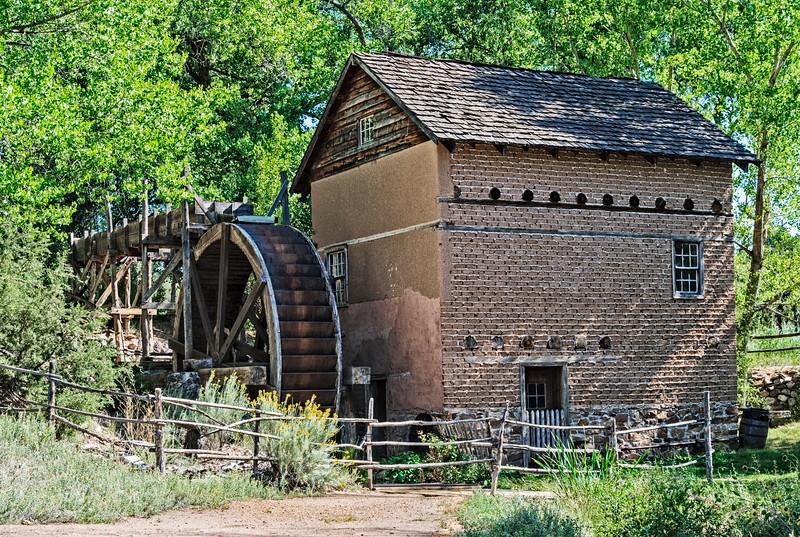
There were two mills on the property, both powered by water.  The larger of the two, had a 20-foot tall overshot waterwheel and was gorgeous.  It dated back to the late nineteenth century and was one of six such large flour mills that had once provided the U.S. Government with enough flour to feed the Navaho.  The government had discovered—much to its consternation—that when people were forcibly moved to infertile land, they had to be fed.  Simultaneously, several industrious merchants learned that it was possible to buy a mill—in kit form—and make quite a profit selling flour to the Army.

This large mill could make over five tons of flour a day, but while the mill was still completely operational, the museum never did run it at capacity.  The old wood and adobe mill could not possibly pass a modern-day health inspection, so we ran the mill at the slowest possible speed and during a day-long demonstration produced 75 pounds of beautiful flour that we were forced to throw away.  (And I did toss it, but first I took it home and ran it through my family’s digestive systems.)

The large complex mill was a wonder to look at and a joy to work in—with all those gears, pulleys, and long leather belts powering the machinery.  It was a marvel what could be done with massive water power.  There was another mill on the property that people hardly ever noticed—a small adobe hut built over an acequía ditch, with a three foot horizontal wheel.  This was one of the last remaining operational examples of the corn mills that Spanish colonists had built using only local materials.

The genius of those small mills—technically gristmills—was their simple design, their home-made parts, and their use of small streams of water.  Despite their simplicity, each was capable of grinding 300 pounds of cornmeal a day.  Without a mill, colonial women had to spend a large part of every day in the back-breaking labor of using a mano and metate (pictured at left) to grind enough corn to make the daily tortillas for a family.  The historical records indicate that such mills were scattered across colonial New Mexico and were probably used communally.

What the records did not show was exactly how such a mill operated.  Since there were no owner's manuals, and no one alive had ever seen one working, restoring the old mill was a lot of trial and error—mostly error.  The ruins of several mills were examined and the remaining debris studied and compared, tested, discarded and tried again.  More than once it was discovered that what had been thought to be a discarded stick or rotting length of leather turned out to be a part crucial to the mill's operation.

Finally, one day, it all worked and after finely adjusting the gaps between the two limestone grinding wheels, we were producing fresh cornmeal.  Have you ever smelled freshly ground cornmeal?  It immediately makes you long for your grandmother's cornbread, fresh out of a warm cast-iron skillet!

Years ago in Mexico, I discovered the incredible taste of fresh-caught trout.  As fast as the fish were caught, they were cleaned, fried, and eaten and then the process was started all over again.  No other fish in my life has tasted half as good as those trout.  I was happy to discover that fresh ground cornmeal produced pretty much the same effect when quickly made into cornbread. 

Naturally, since the old mill was constructed of ancient leather, wood, and adobe, it would never pass a health inspection, either, and we were required to throw the cornmeal away.  Every employee of the museum helped in this task, at a rate of about five pounds at a time. 

Both mills were operational for only a few days a year, during fairs and history days, to carefully demonstrate how people had lived decades in the past.  During one of those days, an elderly woman told us that her grandfather had worked in one of the corn mills back in the 1880’s.  She told us that, besides grinding corn, her father had occasionally ground chile peppers.

This was the first confirmation of something we had already suspected.  In among the abundant  small pieces of wood in the ruins of some of the old mills we had examined, some were faintly stained a dark crimson from chiles.  We knew that at the end of the 19th century, chile ristras had been used as a medium of exchange at trading posts in parts of New Mexico that were so remote that a barter economy was still common as late as the start of the Second World War.  It made sense that the store owner would take those bundles of large chile peppers and have them ground up into chile powder to make the goods easier to transport.

Three of us worked in those mills, and as soon as we heard that woman’s story about her grandfather, we all had to try making fresh chile powder.  Getting hold of 200 pounds of dried red chile was not exactly hard in New Mexico, as chile is still a major agricultural crop.  We put a couple of pieces of plywood across some sawhorses, and started hacking up the dried chiles into rough pieces so we could feed the chunks into the wooden hopper that normally held the dried corn. 

Note.  The country in South America is Chile, the pepper plant grown in New Mexico is chile, the powdered form of this pepper is chile powder, and if you add other spices such as salt, garlic powder and onion powder, it is chili powder.  The latter is used to make a meat dish originating in Texas called chili con carne.  If that dish is made up North by damn Yankees who add everything from lima beans to macaroni, it is called crap.

it took a couple of minutes to find the right adjustment of the grinding stones to produce true chile powder, but in about half an hour, we were producing large quantities of finely ground and wonderfully aromatic chile powder.  We inhaled deeply, the smell was even more pleasing than freshly ground corn meal.  We just stood there admiring the accumulating spice and discussing what we were going to cook with fresh chile powder…

And then we began to cough.  And wheeze.  And had tears running down our faces.  Our eyes burned and our throats were on fire.  Our lips hurt. And the tips of our fingers hurt.  EVERYTHING BURNED AND HURT!

We ran out of that mill, sprinting to the nearest building where we fought over a water hose that was simultaneously desperately needed and absolutely inadequate to the task at hand.  A swimming pool of fresh, cold milk couldn’t have quenched that fire.  Every pore on our skin, everywhere, had somehow absorbed that chile powder and was vigorously objecting to the process.  We had inadvertently produced a military grade biological weapon of mass destruction.  To this day, I wonder why Mexico is not considered a military superpower!

The worst part was that the mill was still running. We still had about 150 pounds of chile to grind up, and since the large hopper was full, it was going to continue the process until the irrigation ditch dried up or the hopper ran out.  We just stood there about 50 feet away, watching a small pink cloud of deadly dust drift out of the mill’s door. 

There was a brief discussion where we considered calling the authorities and having the old mill declared a superfund site, but eventually we began scouring the various museum buildings in search of protective clothing.  Finally, we gathered together enough coveralls, gloves, rain coats, scarves, motorcycle helmets, swim goggles and other assorted gear that we looked like a crew of deranged "Michelin Men".  Picture in your mind what you would wear if you kept a hive of killer bees in Antarctica, and that was about how we were dressed: primitive hazmat suits!

With a little painful trial and error, we discovered that if we held our breath, we could work in that tiny adobe mill for about thirty-seconds at a time.  We eventually, ground up about 30 pounds of chile powder, releasing an estimated additional 20 pounds into the air. 

Given the prevailing winds and the location of that mill, we estimated that most of the noxious cloud eventually blew into the Trinity nuclear testing site, where it should feel right at home with the slowly decaying plutonium.  That’s probably the real reason for all the fences and guards there.

Saturday, March 24, 2018

Weird Lost Weapons


There is something weirdly compelling about the obsolete and rare objects from a bygone era, and for a military historian, this means a fascination with the rare and somewhat weird weapons of the past.

There are weapons that seemingly last forever: the Colt 1911 .45 automatic was used in World War I, and has showed up in just about every war since.  The Browning M2 machine gun has been old enough to qualify for Social Security for a couple of decades now, and is still used by armies around the world, including ours.  Barring the invention of a futuristic ray gun, these weapons will probably still be in use a century from now.

There are other weapons that simply vanished with time, to be lost, forgotten, and never heard from again.  Here are four of them.

The misericorde was a long thin dagger used in European feudal combat during the 14th and 15th centuries.  This was not a primary defensive weapon, but (as the name implies), a tool to be used to “give mercy” to a wounded knight.  In an age when combat was done almost exclusively with edged weapons, even a knight in full armor could be so wounded that a medical recovery was all but impossible.

A good example is the Battle of Crécy in 1346.  At the end of the battle, there were thousands of wounded knights who had fallen to the superiority of the English longbow.  As the English archers scoured the battlefield looking for French knights worthy of being taken prisoner against a future ransom, those too severely wounded were dispatched by these long daggers being thrust through the vision slits of helmets or through the gap in armor at the underarm, mercifully killing the helpless.

Technically, this was a violation of the chivalric codes of warfare, since unwashed common peasants killing noble knights was not allowed.  (This ignores the fact that those same peasants had been killing the knights throughout the battle with anonymous arrows.)  Since rules are usually written by the victors, no one paid much attention to the violations of a code that was dying faster than the French knights.

Some of the misericorde were shaped like an icepick, with long thin cylindrical blades, sometime called a rondel.  Regardless of the shape, their only use was to provide a coup de grâce to armored knights.

How common the practice of actually using the misericorde was in combat is unknown, since no one was keeping records, but a recent post-mortem on the remains of King Richard III indicates that such a dagger gave him a fatal head wound at the Battle of Bosworth.  A short time  later, gunpowder weapons made armor futile, and the need for a long flexible-bladed dagger.

The atlatl once was extremely commonly used, though it’s hard to find anyone still using it today.  Independently developed all over the world, it was probably in wide use from 30,000 years ago up until 500 years ago, and is still used by a few Australian bushmen.  Essentially a short stick with a bowl or hook at the end in which the shaft of a spear fits—effectively lengthening the throwing arm—it allows the missile to travel farther and faster than a traditional spear.  How fast and how far?  The current record is 858 feet traveling at close to 90 mph. 

This stone age Kalashnikov gave early man a frightening hunting weapon, which explains how wooly mammoths were hunted to extinction.  I would love to tell you that an adventurous historian has field tested this experiment by bringing down a modern elephant, but, unfortunately, I can’t.  I can think of a few desk bound historians who I wish would try it, and I’m certain that a researcher could receive a grant for it.  (You can get a government grant to study where your lap goes when you stand up.) 

No, today’s historians are too gentle and too tame to actually kill an elephant with an atlatl, so a researcher used an atlatl on a deceased elephant and judged whether the wound inflicted would have been fatal.  It would have been.

It is ironic that the word ‘atlatl’ is from the Aztecs, who were one of the last peoples to use the weapon in combat.  The Spanish were sorely tested by the Aztec warriors using the weapon, since the both the range and the rate of fire of the projectiles—called darts—were far superior to the primitive harquebuses the Spanish carried.  When Montezuma gave an atlatl to Cortez, he was mystified when the Spaniard was less interested in this formidable war weapon than he was in the worthless, soft yellow metal the Aztecs called “the excrement of the Gods.”

The atlatl is rare today, but may be making a comeback.  Recently, two states—Pennsylvania and Alabama—made it legal to hunt deer with the weapon.  It is probably only a matter of time before it becomes an Olympic sport (while California bans its possession).

Our next invention was also used by the Aztecs.  The maquahuitl was a cross between a sword and a club.  Made from hard oak and three feet long, the edges were embedded with obsidian stones, each sharper than their steel equivalent blades.  Another version of the maquahitl was five feet long and intended to be used with two hands.

According to the Conquistadors, the longer version could completely sever the head of a horse with a single blow.  I can’t prove this, since as far as I know, no historian has actually tried this on a horse, living or dead.  (And it’s probably illegal to hunt deer with them, even in Alabama.)

The Spanish were fascinated by the maquahuitl, so they took numerous examples back to Spain, where examples soon found their way across Europe.  Since the weapon was sharper, and more deadly than the best steel swords in use at the time, this was understandable.  When the great explorer Sir Richard Burton wrote The Book of the Sword, he went into lengthy descriptions of the formidable weapon.  Since the method of working the obsidian into sharp blades was lost after the destruction of the Aztec Empire, the production of the maquahuitl died with it. 

The last rare weapon is the col de mort, the collar of death.  This is a small sharpened metal point to be slipped over the otherwise safely blunt tip of a fencing epee with the aim of turning a safe sporting implement into a murderous weapon.  This is the exact opposite of the safety tip that could be affixed to a regular epee to render the weapon safe during practice.

This is a fascinating device, and without a doubt, the most rare of the four weapons discussed here.  Actually, this weapon is so rare that it may have never existed at all, since the earliest reference I can find of the col de mort is in the 1940 novel, Over My Dead Body, by Rex Stout.  All of the numerous other written references that I can locate were either anecdotal or reference Stout’s work.  And no source that I can find includes a photo of such a device.

Since fencing dates back to the end of the 15th century, and was fashionable long after the sword stopped being a significant weapon of war, it is almost impossible that someone didn’t use a similar device at least once.  When fencing salons were mandatory parts of every aristocrat’s education, there must have been at least one “accident” committed somewhere.

This is exactly why I have included the col de mort in this list.  Somewhere, someone may know of an earlier example.  I’m waiting to hear from you.

Saturday, March 17, 2018

The Building Committee


A little over a hundred years ago, Theodore Roosevelt wanted to show the world that America was a new and great naval power by sending the entire U.S. Navy on a round the world voyage to “show the flag”.  Such an expedition was a costly affair, and a frugal Congress strongly disagreed with the waste of taxpayer money, and promptly cut the annual naval budget in half, to prevent just such a voyage.

Undeterred, Teddy promptly sent the fleet off to circle the globe, telling Congress, “I have enough funds to send them halfway around the world.  If you want the fleet back, come up with the other half of the money.” 

I’ve always wondered if that was what the President of Enema U had in mind a decade ago when the university requested from the state legislature enough funds to replace the aging and cramped old library building.  The politicians knew that the library still possessed plenty of books that the football team had not yet colored, so they gave the Athletic Department a new electronic scoreboard and a crate of new crayons, and gave the administration roughly half the amount necessary to construct a new library.

Since the university president (like all administrators) suffered with a near-terminal case of Edifice Complex, the university constructed a new hemi-library, about a block away from the old library.  The books were cleverly divided between the two buildings in such a feat of legerdemain that it was always necessary to trudge back and forth between the two buildings to conduct any research.  Naturally, it cost twice as much to run two such buildings instead of a single library, but evidently that was the intent of the design specified by the building committee, since the new library was deliberately constructed in such a way that it was impossible to expand it with future construction.

Who knows, in another decade or two, they may add a third library building.  (It will probably include a basketball court).

This is the way universities usually design new buildings—stupidly.  This process is all but guaranteed by using committees, and since I once had the honor of serving on such a committee, I can tell you exactly how the process works.

First, the university ignores all actual needs and decides to erect a new building.  Since the true purpose of any new building is to enhance the résumé of the university president in order for him to move to a larger university with a more successful football program, the project must be something large and impressive.  A new art building, a new performing arts building, or a new semi-library—these are perfect projects.  Since no one would be impressed with a new classroom building, no matter how desperately needed, such mundane structures are rarely constructed.  

It is the stated goal of all universities that as much education as possible should be done online, not actually in a building that requires costly upkeep.  In a future and perfect world, the student will be able to stay home and just send money off to college—a place that will consist of several large multi-story administration buildings.   And a stadium.

After the decision is made to construct a new building, a committee must be appointed to decide on the details.  Most of the members are department heads, faculty members, and assorted administrative toadies—almost none of whom have had any actual experience in construction, design, or engineering, or who will ever actually work in the future building.  At least, that was true of the committee I served on.

The university has whole departments full of engineers, draftsmen, and people with real construction experience—almost none of whom will ever be asked to serve on such a committee.  My committee had two students, a nurse, and several people who didn’t know the difference between concrete and steer manure, and they were the people who monopolized the meetings.

Our first task was to select an architect from the numerous applicants, each of whom had submitted impressive stacks of photographs and drawings of similar buildings that had been built at a rival university.  On several occasions, the committee members actually traveled to other universities and inspected the sample buildings.  All of this was a waste of time, since the architect selected is almost invariably from a firm doing business as far from the local university as possible.  (Remember, the definition of a consultant is someone with an advanced degree who lives out of town.)

Now the newly selected architect will spend hours and hours with the committee, making lists of the required features.  Most of the suggestions will be idiotic or contradictory, and the architect will promise to include them all.  Of course, the new building will be “green” and energy efficient.  Of course, the new building will blend in with the campus, be beautiful, and attractive…  And so forth.  In the end, the actual building will be a stuccoed concrete horror with tiny windows that don’t open, closely resembling a bus station or a prison, and surrounded by landscaping selected by morons who have never lived in New Mexico.

Take that new demi-library building:  for some reason the architect decided that a new building erected in the middle of the Chihuahuan Desert should be surrounded by palm trees.  Evidently, he thought all that local sand was a beach.  To be fair, I will grudgingly admit that a building surrounded by tumbleweeds might not look attractive on the photos shown by our recent president at his next university.

The new building that my committee was tasked with designing was actually remodeling and combining two existing buildings and adding a few desperately needed classrooms.  The committee met for weeks and heard ideas of what the new classrooms should look like.  Most of the talking was done by people who had no recent experience in teaching—a universal requirement for administrators.  These same administrators were never going to teach in the new building, either.

The traditional design of large classrooms is fairly simple:  long rectangular spaces with the floor sloping downward to the front of the room, where raised platforms holds a lectern and the walls hold blackboards.  The rooms contain either desks or tables at which the students can sit and take notes.  Lately, modernized classrooms contain computerized projectors, white boards, and large screens, but the basic design has not really changed since  the days of Socrates.

President Garfield once defined the ideal college as a log with Mark Hopkins (his mentor) on one end and a student on the other end.  I wish to hell Garfield had been on my committee.

No, it turned out that both President Garfield and I were wrong.  Over and over again, experts told the committee that the “Sage on the Stage was dead.”  Lecturing was out and education now was cooperative learning in a reciprocal environment that would lend itself to group work.  The floor would be flat (no raised stage), the desks would be on wheels for ease of rearrangement into different groupings, and “every wall would be a learning wall.”

“Imagine,” I said, “that you are a history professor with one hour to explain the Protestant Reformation to eighty freshmen who took high school history from a football coach who thought the Renaissance was a casino in Vegas.  How the hell do you do that in a room where every other desk is facing the wrong way while students are staring at a learning wall, waiting for a movie to start?”

I never did get an answer.  

None of this deterred my committee and we rarely agreed on anything.  It was at this point that the goals and aims of the committee began falling apart like a leper on a pogo stick.  It turned out that only one voice mattered—the dean.  She appointed enough new committee members from her staff she got what she wanted—including a machine that would generate the smell of fresh baked bread.  The building wouldn’t get the actual bread, just the smell.

We were tasked with designing a horse and in due course provided a blue print for a two-headed camel.  The design was to connect the existing two buildings with lots of open interactive spaces where professors could mentor students after class, with study corners, and with new offices for administration where there had once been several serviceable, if old, classrooms.  The resulting new building would have been a nightmare to construct, would have been as ugly as a mud fence, and would have been about half as useful as the two original buildings had been.  Frankly, the state could have saved a ton of money by simply updating the existing two buildings, but that was never even contemplated.

So, after a year of hard work, the committee was thanked for its work, was congratulated for the finished product, and was dismissed.  The state had appropriated a set sum of money to remodel two existing buildings and add more classrooms, and my committee had done—mostly—its job.

Then the administration threw away the plans, bulldozed down both buildings and erected a new one with fewer classrooms capable of seating fewer students. 

Typical.