Saturday, June 29, 2024

Can A Candidate Be Replaced?

Like most Americans who watched the debate between Trump and Biden last night, I quickly concluded that Joe Biden is unlikely to be the Democratic Party candidate on November 6, 2024.  The problem is not Joe Biden’s age, but his mental capacity to hold the office.

There are a few problems with replacing Joe Biden as the Democratic Party candidate, however.  Biden has already won enough state primary delegates—3,894 out of 3,937–to guarantee capturing the party nomination at the convention in just 52 days.  Assuming that President Biden does not voluntarily withdraw (which seems unlikely as I write this), he is guaranteed the party’s nomination.  

Note.  Actually, as of this date, Biden will officially win his party’s nomination before the convention.  Because Ohio state law specified that a party’s nominee must be selected at least 90 days before the election to qualify to appear on the ballot, the Democratic National Committee has agreed to hold a virtual roll call early in order to officially nominate its candidate before that deadline.  Of course, since the DNC announced the virtual roll call, the Ohio legislature has passed a law that relaxes the deadline, so it is possible that the DNC will decide not to hold the virtual roll call.  If the roll call is canceled, that would be a solid indication that the party is seeking to replace Biden as the front runner. 

It is also important to remember that if President Biden decides not to seek the nomination this year, Vice-President Kamala Harris does not automatically become the party’s nominee.  Harris has no pledged delegates and those currently pledged to Biden are under no obligation to support the nomination of Kamala Harris.

If President Biden were to announce that he is not seeking the nomination, this would result in an open convention in which all of Biden’s delegates would be released from their obligation to vote for him and they would be free to pick a new candidate.  This scenario has happened twice in recent history.  In 1960, both John F. Kennedy and Lyndon Johnson sought the nomination and they eventually reached an uneasy compromise in which, although the two men clearly did not like each other, Kennedy topped the ticket and LBJ agreed to run as his vice-president.

The other example is from 1968, after President Lyndon Johnson surprised the nation in March, just five months before the convention, by announcing he would not seek his party’s nomination.  The president’s late withdrawal had a profound impact on the 1968 presidential race and the dynamics within the Democratic Party leading up to the convention.  This convention was notable for its contentious atmosphere that saw protests and clashes both inside and outside the convention hall.  The disastrous convention in Chicago was a significant factor in Democratic candidate Hubert Humphrey’s losing the election.

Assuming that Biden does not voluntarily withdraw and that he successfully secures his party’s nomination, his nomination can still be ended and he can be replaced by the party with a different candidate.  The rules adopted by the DNC have two provisions for officially changing the candidate.  The first rule deals with death, declination, or disqualification: If the nominated candidate dies, declines the nomination, or becomes disqualified before the general election, the Democratic National Committee has the authority to fill the vacancy.

There is a historical precedent for this in the Party.  Senator Thomas Eagleton was selected as the running mate for Senator George McGovern in the Democratic Party's presidential ticket, in 1972.  After it was revealed that Eagleton had undergone electroshock therapy twice for depression at least six years before.  Since the diagnosis and treatment were considered liabilities at the time and were believed to make him potentially unfit for office (as well as potentially jeopardizing McGovern’s chances of winning), Eagleton “withdrew” from the ticket on August 1, 1972, and was replaced by Sargent Shriver on August 8, 1972, just before the Democratic Convention.  

After Eagleton’s medical history became news but before he withdrew, Senator McGovern on several occasions stated on several occasions that he was “behind Eagleton 1000%”—an infamous phrase that in later decades would be called a meme for imminent abandonment.  While McGovern still probably would have lost to Nixon, the Eagleton incident underscored broader concerns about McGovern's campaign readiness and decision-making process, which Nixon's campaign capitalized on to reinforce doubts about McGovern's candidacy.

The other rule the Democratic Party could use to remove Joe Biden from the election is a little less clearly defined.  “The Democratic National Committee (DNC) has the authority to fill vacancies that may occur on the national ticket due to death, resignation, or other circumstances deemed appropriate by the DNC.”  In other words, if the majority of the DNC determines that a candidate is not fit to run, the committee can remove that candidate and either reconvene a convention or (and this is more likely) select a new candidate by a consensus of the committee.

Picking a new candidate this way would have enormous difficulties.  First, it would certainly alienate Biden supporters and raise suspicions of the DNC acting unilaterally and eliminating voter choice.  It would also face severe financial hardships because the campaign funds raised by Biden would remain under his control and could not be transferred to the new candidate.  Even with Biden’s approval, under campaign finance rules, all Biden could do—if he were willing—would be to transfer the funds over to a PAC supporting the new candidate.

If Biden is to be replaced on the ticket, whether voluntarily or not, the clock is ticking.  Even if the Democratic Party delays until after the second debate on September 10 to decide, it may be too late to mount a campaign for a new candidate.  Early voting in some states starts in September, with at least one state accepting ballots even before the second debate is scheduled to air.

If the Democratic Party waits until September to pick a new front-runner, it will lead to court challenges over delegates or over whether the ballots can be reprinted in time to be mailed out to voters.  In some states the only way to vote for the Democratic nominee might be by a write-in vote and those voters who marked ballots for Biden would likely be disqualified.  By comparison, the chaos of an open convention would seem preferable.

There is one more historical example worth mentioning.  In 1884, the Republicans nominated James G. Blaine as their candidate for President.  Blaine was a former Speaker of the House whose reputation had been tarnished by a scandal in which the Union Pacific had purchased worthless bonds at their face value from Blaine in exchange for political favors.  While Blaine vehemently denied the charges, a former aide produced letters from Blaine that not only confirmed the story, but which letters ended with the phrase:  "Kindly burn this letter."

Though their candidate's reputation was massively damaged, the Republican Party ignored popular sentiment and gave Blaine the nomination.  Anti-corruption Republicans, known as Mugwumps, crossed party lines and supported the candidacy of Democrat Grover Cleveland.  The presidential race turned into an ugly popularity contest, with both sides tainted by scandal.  Grover Cleveland was accused of having fathered a bastard child, with critics singing out,  "Ma, Ma, where's my Pa?".  The Democrats retaliated with the cry:  "Blaine, Blaine, James G. Blaine, the continental liar from the state of Maine, 'Burn this letter!”

The election was very close and Blaine came within a quarter of one percent of winning the popular vote while Cleveland won solidly in the electoral college, 219-182.  The Democratic Party, which had been out of political power since the Civil War, won not only the White House but control of the House of Representatives.  Two years later, the Republicans also lost control of the Senate.

All of this makes me a little happy I’ve retired.  I pity the history professors who will have to stand in front of rooms full of students and try to explain presidential history from 2016 to 2024.  Forgive me in advance for assuming that 2028 will be a return to normality.  But then, after the last eight years, who knows what “normal” is?

Saturday, June 22, 2024

Extra Slow Charging Stations

My brother was a car guy, as are my two sons.  The boys really like cars, know a great deal about them, can accurately recognize models at a great distance, and take great enjoyment from owning and driving the right car.   

That’s not me.  I don’t particularly like cars and I use them because I need them.  So, I’m not really against the idea of electric cars—I’m just a little hesitant to buy one until they become practical.  I understand enough about the technology to see current limitations, and I live in a part of the United States where I could probably find an antelope or a buffalo more easily than a charging station.  That will change in time and I would bet money that an electric vehicle is in my future…it’s just a question of how distant that future is.

That said, I’m really skeptical about how our government seems to be pushing the rapid adoption of the electric vehicles (EV) onto the public before the technology is ready for the market.  Despite tremendous pressure by the federal government on automobile manufacturers to ramp up EV production, Ford, General Motors, and Mercedes have all announced they are scaling back production, deciding instead to focus on the more practical hybrid vehicles.  After losing $5 billion, Ford admitted the painful truth:  the current state of battery technology is not yet advanced enough to make a plug-in EV practical for everyone.

Someone needs to tell Washington this as our politicians all seem to believe that the saga of King Canute was a success story.  To remind the education majors, King Canute had his ministers place his throne on the edge of the sea as the tide came in.  In spite of Canute’s ordering the waters to recede, the tide kept moving inland, reaching the king’s knees before he gave up and decamped to dry ground.  This was an object lesson in which the king was trying to teach his ministers that all power—even the king’s—is limited.  Government seems to believe that simply passing a few new laws (or issuing new bureaucratic rules) will overcome the lack of technological breakthroughs.

Besides raising emissions standards to discourage production and sales of gas-powered vehicles, our government has allocated $7.5 billion to build half a million charging stations along the nation’s highway by 2030.  Evidently, a Tesla behaves like the finches in my backyard, who won’t show up until you put food out for them.  Since one of the big reasons people are reluctant to purchase EV’s is their fear being stranded along the highway from the lack of charging stations, increasing the number of charging stations should promote sales, right?

There is one large problem with the program, however:  after two years and spending an incredible amount of money—the Department of Transportation is happy to announce that the program has produced eight more charging stations.  That’s not a typo—they’ve made eight.  There are hundreds in the process of being constructed, but despite the incredibly large budget, completion of half a million stations by the year 2030 is never going to happen.  At the current rate of construction, in fact, we will reach that goal in only another 125,000 years.  This gives us something to look forward to.

Before we look at the reasons why the government can’t seem to build charging stations, we should look at why the private sector isn’t meeting the demand.  The answer, of course, is that building charging stations is not profitable enough to attract investment.  There aren’t enough electric vehicles on the road, the owners of the few existing vehicles tend to charge their vehicles at home, and the profit margin is so low that commercial establishments can’t charge enough for their use to recoup the investment necessary to install the equipment.  The only reason that any establishment would make the investment is to increase traffic volume and, so far, there just aren’t enough EV’s on the road to generate enough business to merit the investment.

The Department of Transportation is encouraging states to apply for that $7.5 billion, but while every state eagerly indicated it wanted the money, fewer than half have even requested that companies submit bids for the construction of the charging stations.  And there are some valid reasons why the states are moving so slowly.

It seems that the allocation of the money has to be approved by the White House Environmental Justice Advisory Council—the body that makes sure that the funds spent ensure that the "voices, perspectives, and lived realities of communities with environmental justice concerns are heard in the White House and reflected in federal policies, investments, and decisions."

In other words, if you want to submit a bid to build one of those charging stations, your firm submitting the lowest bid does not mean you will get the contract.  You will also have to "demonstrate how meaningful public involvement, inclusive of disadvantaged communities, will occur throughout a project’s life cycle."

Yes, the quotes are directly from the Department of Transportation documents.

I have this sneaky suspicion that paying taxes, providing jobs, and selling a valuable service at competitive prices will not qualify as “meaningful public involvement” to the bureaucrats at the Department of Transportation.  Thankfully, the department gives guidelines on how to include "intentional outreach to underserved communities."  A company submitting bids should include evidence of having hosted "games and contests," "visual preference surveys," or "neighborhood block parties", including proof that the grant recipient provide "multilingual staff or interpreters to interact with community members who use languages other than English."

While not absolutely required, the Department of Transportation also advises applicants to “promote local inclusive economic development and entrepreneurship such as the use of minority-owned businesses,”.  To qualify, applicants can submit proposals to fund “support services to help train, place, and retain people in good-paying jobs or registered apprenticeships, with a focus on women, people of color and others that are underrepresented in infrastructure jobs.”

Can you imagine a small business staring at these nebulous “requirements” and then deciding to pursue the relative low profit that winning the bid would provide?  Can you imagine actually sitting down and writing such a proposal?  The end result would read more like a term paper for a sociology class than a proposal for a construction project.  

So, don’t expect those half a million new government-built charging stations anytime soon.  And by the way, that same White House Environmental Justice Advisory Council also oversees the funding for several hundred other government agencies, all of which are probably equally quagmired in endless and needless paperwork.

America will eventually get those half million charging stations, but that will happen because there will be sufficient public demand to incentivize the free market to produce them.  

Saturday, June 15, 2024

Not Worth a Continental

“That’s not worth a continental.”

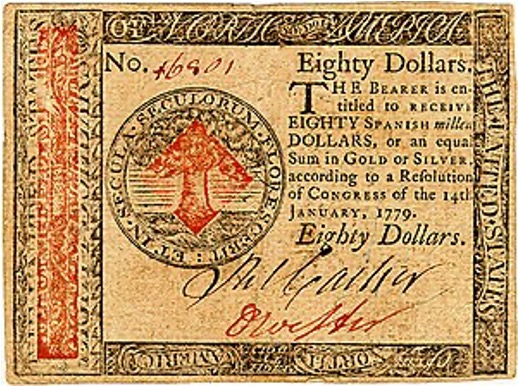
I think I dimly remember someone using that expression back in the sixties.  And I’m sure that I have either heard it or have used it in a history classroom.  The expression refers to the highly depreciated value of the currency—called “Continentals” because they were issued by the Continental Congress during the Revolutionary War.  

Issued in denominations that would be strange to Americans today—the face values ranged from a sixth of a dollar to eighty dollars—they were needed by Congress to finance the war.  Since Congress printed an enormous supply of the bills, the currency dropped rapidly in purchasing power.  By the time production of the the bills stopped, the accepted value had declined to a thousandth of the printed value.  (Yes, the Continental Congress actually printed a three-dollar bill.)

Besides the out-of-control spending by Congress, there was another reason the bills had lost value, a reason that borders on art crime, the 9bills were being professionally counterfeited.  Almost as soon as the bills were announced, over a dozen counterfeiters leaped at the opportunity to produce bogus bills, secure in the knowledge that merchants couldn’t possibly detect a forgery since almost no one had seen the real bills.

Though these bogus bills contributed to the inflation by increasing the money supply, the combined efforts of the American counterfeiters paled in comparison to the professionally produced bills printed by the British government!  As soon as the Continental Congress announced the new bills, the British Navy recognized an opportunity to not only recoup a small part of the cost of prosecuting the war, but a method of destabilizing the rebellious colonial government.

Since the British Navy firmly occupied New York and its harbor, it hauled a printing press out to the HMS Phoenix, where the counterfeiting operation could be conducted securely.  Once in production, operating with the best of equipment, personnel, and supplies, the ship produced such high quality bills that the British advertised the bogus money for sale in New York newspapers, offering to sell the fake bills for only the price of the paper.  

The operation was so successful that not only did the bogus bills trigger inflation, but by the time the Continental Congress quit printing the bills, over half the currency in use throughout the colonies was counterfeit.  There were even documented instances in which legitimate bills were refused by merchants because they did not resemble the widely circulated British fakes closely enough.

After the Revolutionary War, the new Federal government stopped printing currency, relying on gold and silver coins.  Since there was not enough official bills, unofficially America continued to use coins produced by other countries—particularly the Spanish silver dollar, commonly called pieces of eight.  Since there was a shortage of smaller denomination coins, merchants cut the Spanish coin into eight pie-shaped pieces, hence giving rise to a quarter of a dollar still being called “two bits”.  Spanish dollars were still being accepted as legal tender until Congress passed the Coinage Act of 1857.

Because official coins were in short supply, regional banks issued their own money (a $50 BankNote from the Planter’s Bank of Tennessee for example.  There was an informal method of exchange between the banks, and the banknotes were in wide circulation throughout the country.  In addition, since thousands of banks across the country were producing their own banknotes, counterfeiters could not only copy the banknotes, but could print bogus money for fictitious banks.

During the American Civil War, the American government needed to spend more money than it could possibly acquire in gold or silver, necessitating the production of paper money again.  And once again, counterfeiters rushed to produce bogus copies of the new bills and pass them along before the public knew what the new bills looked like.  By 1864, once again, over half the currency in use in the North were actually counterfeit.  

Surprisingly, counterfeit bills were also widely in use in the South.  Since the public had lost faith in Confederate currency, they were eager to obtain the new Northern official bills.  Which brings us to the strange story of Samuel Upham, a Philadelphia shopkeeper who ran a small stationery store.

When the war started, Upham began selling envelopes emblazoned with flags, cashing in on the rise in patriotic feeling.  And when he noticed that customers were willing to pay for the few examples of Confederate money sent home by Union soldiers, Upham suddenly had a brainstorm.  While it was against the law to counterfeit American money, what law did it break if he were to print fake Confederate money?

To test the market, Upham took a real Confederate five dollar note and printed out 3,000 copies of it.  Selling them for a penny each, Sam sold all of them in just a few days.  The next batch he printed was larger—80,000 bogus bills.  Since Sam intended them to be souvenirs, not actually passed as counterfeit bill, on the bottom of each bill, he added a small byline:  “Facsimile Confederate Note—Sold wholesale and retail by S.C. Upham 403 Chestnut Street, Philadelphia”. (The bill at right is an Upham facsimile.)

To sell the “souvenirs”, Upham advertised them in the leading Northern publications such as Harper’s Weekly and the New York Tribune.  Upham’s notes were a tremendous success.  So much so that he began printing other denominations of Confederate money and stamps.

While it was illegal for individuals in the North to do business with the states in rebellion, a lot of businesses ignored the prohibition, particularly cotton buyers.  These businessmen bought large quantities of the souvenirs, cut the small bylines off the bottom of each bill, then used the souvenirs to pay for their purchases, realizing an enormous profit margin.

Upham was so successful that he raised the price of his souvenirs to a nickel each, but that the price increase did not slow sales.  By the time he stopped production, Upham had printed 1.56 million fake bills with a face value of $15 million dollars, netting Upham a profit of over $50,000–an amount worth over a $1 million in today’s money.

How much Upham’s bills had to do with the rampant inflation is impossible to calculate.  Upham may have even had unofficial assistance from the Union government, there is an impossible to substantiate rumor that Secretary of War Edwin Stanton secretly channeled high quality banknote paper to Upham to increase the quality of the bogus bills.  According to Senator Henry Foote, Samuel Upham did more damage to the Confederate cause than General McClellan and his army.  (Seeing how in most battles McClellan just barely managed to clutch defeat from the jaws of victory, Foote may have been correct.)

In 1863, Upham stopped production of his facsimile bills, possibly because demand for the bills had finally died out, or possibly because the Confederacy put a $10,000 bounty on his head.  Today, you can buy a “real” Confederate bill for fairly cheap—I have several.  Ironically, if you want an example of a Upham “souvenir”—they cost two to three times as much as a legitimate Confederate bill.

Saturday, June 8, 2024

The Old Cowboy

The old cowboy slowly saddled his horse and rode down the dirt road past the fields where a few head of cattle were taking advantage of the cool morning to graze the grass.  There had been a time when the cattle had belonged to the old cowboy, but now he just let his neighbor pay him for the grazing rights.  When asked about it, the old cowboy used his age as an excuse, but he could admit to himself that the real reason was that since his wife had passed away, he no longer had the heart to work his own cattle.

Slowly, the old cowboy rode down the dusty two rut track that led to town.  As he passed his neighbor, he saw that the family, dressed in their best, was getting into their buckboard, obviously on their way to Sunday services in the town.

“Morning John!  If you’re heading to church, you’re welcome to ride in with us,” called his neighbor.

“Thank you, but I have things to do,” he replied and let the horse make his own way down the trail to town.

The man helped his wife step up into the buckboard.  “I wish we could get Old John to come back to the church.  I hate to think about him living all alone with no company.”

“That man hasn’t done anything but drink whiskey since Martha died.  She was the only one to keep that man in line, but now that she’s gone there is no hope for the man—might as well try to make a pet out of a coyote.”

The old man continued on his way to town, passing two other families on their way to church.  He had been a regular churchgoer when his wife was alive, but since her passing, he just didn’t see any reason to continue attending.  Besides, he never really felt lonely because he was always surrounded by his memories. 

As his horse made his way through the small settlement, John nodded to the parson who was stepping off the boardwalk that ran in front of the small collection of shops that created the center of town.

“We haven’t seen you in quite a while, John.  Will you be joining us today?

“Sorry Parson, but I have somewhere to be today.”

“You know Martha would want you to come to church.  Why don’t you come in and we can pray together?”

“My wife always got a great comfort in going to church, and I wanted her to be happy.  She’s gone now and while I appreciate your concern, Parson, I’m not going to find her in your church.”

“If you change your mind, John, you know you will always be welcome.”

The old cowboy tipped his hat and silently rode on through the town.  He didn’t look their way but felt certain that there were people gathered around the small clapboard church, who were watching him, disapproving of his actions.  He knew that he was the subject of gossip in the small town, but truthfully, he probably cared more about the opinion of his horse than that of his neighbors.  

Leaving town, he headed west into the open prairie, moving at a slow walk, for there was no hurry.  He watched a lone turkey buzzard circling in the sky, looking for something to eat.  He watched the last few leaves in the scrub oak move with the afternoon wind.  He stopped at the solitary stream and let his horse water and nibble on the green grass along the bank.  While the horse refreshed himself, the old cowboy drank from his canteen and ate the cornbread and bacon he had carefully packed into his saddle bags.

As the sun descended, casting hues of amber and gold across the vast expanse of the western sky, the aging cowboy rode slowly across the rugged terrain.  His weathered face, etched with lines of experience and wisdom, reflected the hardships of a life spent under the relentless sun and endless horizons of the open range.

Leather creaked softly with each movement of his weary mount, the faithful companion who had borne him through countless trails and trials and who was probably the last living creature on earth that the old cowboy cared about.  The rhythmic, slow clip-clop of hooves echoed against the backdrop of fading daylight, marking the passage of time as the cowboy journeyed onward.

With each passing mile, memories flickered like distant stars in the twilight sky.  He recalled the days of his youth, the days when he thought the task was impossible.  He remembered the miracle of Martha agreeing to be his wife and the hard years of building their ranch together.  And he remembered the nights when she laid her head on his shoulder while they slept.  But now, as the years waned and shadows lengthened, he only found solace in the quietude of the open range, where the echoes of the past mingled with the whispers of the wind.

Finally, he reached the spot he had spent the day traveling to, arriving just as the sun was low in the sky in front of him.  Dismounting, he tied the reins to a nearby salt cedar, though he was sure his tired horse was not interested in leaving him.

As the old cowboy removed his hat, he dropped to his knees in prayer.

“Hello, Lord.  It’s me again.  Are you taking care of my girl?”

Saturday, June 1, 2024

The Most Successful Art Thief in History

The semester is over and while I’m no longer studying for classes, I find I cannot stop reading about art.  Lately, I’ve been reading about the fascinating history of art crime.  I find myself taking endless notes about forgeries, art thefts, and museum burglaries.  It’s habit forming—I even found myself writing lecture notes on the subject before I remembered I’m retired and am no longer in that business.  

Art theft is particularly interesting.  However, I’m not referring to the staggering amount of art theft associated with military conquest, such as the plundering done by Hitler, Napoleon, or Joseph Bonaparte—I’m referring to the individual art theft done by a single person for his own profit.

Did you ever notice that art thieves on television or in the movies are always sophisticated and handsome men who pull off complicated but ingenious heists?  In addition, the victims are always wealthy individuals whose losses will never result in a missed meal or a late mortgage payment.  The insurance company gets gouged, but we all hate insurance companies so there is no real harm done.

Have you ever noticed how often art thieves pull off their capers while wearing their tuxedoes?  Cary Grant in It Takes a Thief, Pierce Brosnan in The Thomas Crown Affair, and Sean Connery in Entrapment.  Do you think it is a coincidence that two of the above also portrayed James Bond?  

In reality, art thieves are not the sophisticated debonair men about town portrayed in the movies—they are rather ordinary people.   According to the Art Theft Division of the FBI, the only common trait of successful art thieves is that they are predominantly male.  This might be correct, or just possibly, female art thieves are so good at their work that they are rarely caught.  (I saw Sandra Bullock in Oceans Eight.)

In any case, the most successful art thief in history is Stéphane Breitwieser—someone you probably have never heard of.  Instead of being a sophisticated, urbane cat burglar, Stéphane was a waiter.  (Though it’s possible that he wore a tuxedo while working in the restaurant.).  Nor did Stéphane live in a chateau financed by his ill-gotten gains.  No, Stéphane did not steal the priceless works of art to sell:  he stole them for his own private collection in his bedroom at his mother’s house.  If you are looking for sophistication, the best I can do is tell you that Stéphane was French.

After graduating from high school, Stéphane had no formal education in art, but worked as a security guard at an art museum, where he noticed that, for the employees of the museum, the art on the wall all but vanished as they focused on the visitors.  According to what Stéphane said at his later trial, no one who works at the museum actually sees the artwork.

By the time Stéphane was 23, he and his girlfriend, Anne-Catherine Kleinklaus, lived in a couple of attic rooms in his mother’s house.  He was usually unemployed working infrequently as a waiter.  When the two visited a museum in a small town, Anne-Catherine stood watch while Stéphane slipped an antique flintlock into the waistband of his trousers and covered it with his overcoat.  A year later, the duo stole a medieval crossbow from a different museum.

By now, Stéphane had developed an obsession with “collecting” sixteenth and seventeenth century artwork.  The pair frequented small museums where the security was lax and while Anne-Catherine distracted the guards, Stéphane would steal the priceless artwork.  Sometimes, Anne-Catherine would stand lookout while Stéphane dismantled a display case or removed the nails holding frames to the wall, warning her boyfriend with a fake cough to temporarily stop work.

You would think that such unsophisticated thefts would inevitably lead to a short career in art theft, but in just six years Stéphane stole 239 works from 172 museums across Europe—valued at just under $2 billion dollars—and sold none of them.  Instead, he crammed the works into the attic and bedroom of his mother’s house.  According to the thief’s own testimony at his later trial, he liked to be secretly one of the richest men in Europe.  Clearly obsessed with stealing art, he stole a valuable work on average once every two weeks.

Perhaps the most valuable painting the pair stole was the painting of Sibylle of Cleves by Lucas Cranach the Elder (right).  The painting was valued at more than $10 million when Stéphane walked into the Sotheby’s auction house, cut the painting from its frame and hid the canvas under his coat as he walked out.  (If you don’t know who Sibylle is, you have probably heard of her sister, Anne, who married Henry VIII.)

Once home, Stéphane took great care of his art collection, often having paintings reframed by a local art supply store who believed his story about collecting reprints.  He kept the attic windows covered so the sun would not fade the paintings and frequently rearranged the collection to maximize his viewing pleasure.

Another well-known painting stolen by Stéphane is the Sleeping Shepherd by François Boucher.  Once again, the painting was cut from its frame, rolled up and hidden under the thief’s overcoat.  

Stéphane’s first arrest occurred in Switzerland in 1997 when he and Anne-Catherine tried to steal a landscape from a private collector who had graciously given permission for the two thieves to see it.  As they fled with the painting, the owner was able to run out of his home and get the license plate of their car.  While Anne-Catherine was able to make her way back to France, Stéphane was arrested and tried.  Since this was his first offense, he was given an eight months suspended sentence and banned from reentering Switzerland.

One of the real problems with art crime is that the courts rarely give offenders lengthy sentences.  Steal a thousand dollars from a bank in the United States and the typical sentence imposed is 105 months in prison.  Steal a million-dollar painting and you will probably get probation.  Evidently, the judges watched all those movies we discussed earlier.

Stéphane, predictably, kept on stealing artwork.  He didn’t even stop working in Switzerland, just started using his mother's maiden name.  His second arrest was in 2001, when he returned to a museum to erase the fingerprints he had inadvertently left when he stole an antique bugle the day before.  Unfortunately for the art thief, the security guard recognized him from the previous day.

It took the Swiss authorities almost three weeks to obtain an international search warrant to get into the French house where ample evidence was found for a trial.  Stéphane received a three-year sentence (but served only 26 months), Anne-Catherine was sentenced to 18 months (and served six months).  Unfortunately only 110 pieces of art were recovered.

Which brings us to Stéphane’s mother, Mireille Breitwieser.  When Anne-Catherine returned home after the 1997 arrest, she told Mireille the whole story.  Concerned that the police would inevitably arrive literally on her doorstep, she began systematically destroying the artwork.  Paintings were cut into small slivers and fed into her kitchen garbage disposal.  Vases, statues and anything else that could not go down the kitchen drain was thrown into a nearby river.  

While the painting of Sibylle survived, many paintings did not.  One of the paintings that went into the disposal was the Sleeping Shepherd.  For the destruction of so much artwork, though she claimed she had no idea of the value of the artwork she destroyed, Mireille was sentenced to 36 months (and served 18).  Dredging and diving efforts in the river eventually recovered 107 works of art.  One of the destroyed works, Cheat Profiting From His Master by Pieter Brueghel was not only destroyed, but no surviving photograph of the work has been found.

Since his most recent release from prison, Stéphane has been arrested twice more for art theft, and was given short sentences each time after the police recovered dozens of stolen artworks from that same house.  Currently, he is under house arrest and has been ordered to wear an ankle monitor.  It seems to be inevitable that we will eventually hear about him again.

Friday, May 24, 2024

The Fort Worth/Dallas Greater Metroplex

The Doc and I just got back from visiting the Dallas half of our grandkids.  As the oldest of the bunch was graduating from high school (yes, I’m that old), it was an excuse for both of my sons, What’s-His-Name and the The-Other-One, and me to play computer games together and drink beer.   Naturally, this upset the women, so we turned off the computers and binge-watched BeardMeatsFood on YouTube and drank beer.  

BeardMeatsFood ought to be compulsory watching at Weight Watcher meetings.  Where does such a skinny guy put all that food?  I watched the guy eat a 72-ounce steak and a monster basket of French fries, then ask for the dessert menu.   After that, I could barely finish a salad for dinner.  And is there anything more indicative of First World Problems than the existence of competitive food eaters?

After the graduation party, when he asked me what I wanted to do, I immediately dragged my son down to Dealey Plaza to go through the museums, particularly the excellent new Holocaust Museum next to the infamous School Book Suppository Building.   He really wasn’t surprised as I’ve inflicted museums on him in six countries.  So far.

Besides the museums, we took the compulsory walk along Elm Street and looked at the large ‘X’ painted on the tarmac.  As I turned and looked back towards the sixth floor, I couldn’t help but wish for the tree to have been that tall sixty years ago.

As I slowly walked towards the grassy knoll, I encountered a wild-eyed old man with crazy white hair and I knew instantly that he was some kind of half-witted conspiracy loon who was going to grab my arm, drag me to the top of the small hill, all the while lecturing me on “who really did it”.  Then, from the raised eyebrows and concerned look on his face, it suddenly dawned on me that the poor man was seeing the same apparition approaching him and fully expected me to behave the same way.  Luckily, we passed each other without incident.

It is probably a good thing that I don’t live near Dallas.  I would probably visit that grassy knoll once a month, hiding empty rifle shell casings like easter eggs for the fools who gather daily, intent on discovering the long-lost clue that has evaded everyone else for the last six decades.

“Look, Myrtle!  There it is, behind the tree!  I knew it all along…the real killer was here!”

Dallas has certainly changed in my lifetime.  I remember when, if you traveled east from Fort Worth on the newly completed turnpike, first there were fields and cows, then Arlington and the construction site where they were building Six Flags, followed by more cows and fields and then you hit Dallas.  Today, the Dallas-Fort Worth Metroplex spans than twelve counties and is the fastest growing metropolitan area in the United States.

A five-minute drive down any freeway shows what is probably more new commercial construction than exists in all of New Mexico.  One of the really striking features is the erection of vast warehouses and factory complexes with signs offering space to rent, meaning that investors are so confident of finding potential lessees that they are building large commercial buildings in advance of need.  The whole metroplex is attracting business and people eager to seek lower crime, relief from state income tax, and a business-friendly atmosphere.  

The area now has a population larger that eight million, it has an economy that is larger than Houston’s and only slightly smaller than Chicago’s, and it is still growing.  If the area were an independent country, the economy of the new nation would rank in the top twenty—right above Switzerland and the Netherlands.  And the economy is growing faster than most of those countries above it on the list.

Let’s project the current economic trends into the future just a little bit—say, 25 years.  This requires us to do a little guess work and to make a few assumptions.  If current trends continue, we are likely to see continued economic flight from New York, Chicago, and Los Angeles while we see continued growth in the already massive Dallas-Fort Worth Metroplex.  In just 25 years, both the economy of and the population of the area will be larger than Chicago’s, which will drop to fifth place in the nation (lower than Houston’s).  The top two spots will remain New York and Los Angeles, while the total economy of Texas will come close to tying the economy of California.  

This kind of economic growth invites comparisons with the economy of neighboring New Mexico, where economic stagnation is the rule.  It wasn’t that long ago that the headline story in my local newspaper heralded the opening of a new coffee shop.  Sadly, the most valuable export from New Mexico is neither energy nor green chile, but our educated children, who must leave the state in search of good jobs.

I hope New Mexico never becomes as populated as Fort Worth and Dallas are about to become, but we could use little more economic development, at least enough to create some jobs, raise the standard of living, and keep our children from leaving the state.  

Politically, New Mexico has looked to California as a role model for our economic policy.  Perhaps it is time we looked at what is working in Texas.

Friday, May 17, 2024

The Books Lost on the Titanic

When the Titanic sank April 15, 1912, there was, indeed, a tragic loss of life.  Of the  2,240 souls who sailed on Titanic, over 1500 men, women, and children went down with the White Star liner.  Widows and orphaned children mourned their losses, and the loss of an “unsinkable” ship caused a shock wave that is still rippling across our culture.  Since three times as many first-class men survived in the lifeboats as the number of steerage class children who drowned, the myths of class and male chivalry were severely challenged.

Note.  Everyone knows that Captain Smith went down with his ship.  Roughly 75% of the crew perished when the great ship sank.  Less widely known is that the crew included two children, Frederick William Hopkins (Plates Steward) and William Albert Watson (Bellboy), both only 14 years old.  Exactly what happened to the two children is unknown, but neither made it to the safety of a lifeboat.

Besides the immense loss of life, the sinking of the RMS Titanic also resulted in the loss of valuable cargo, including works of art, a valuable and rare book, and the property of all those who were traveling on the ship.  Did you know that part of that lost cargo included some important and irreplaceable books?

Probably the most valuable book lost with Titanic was a jewel-encrusted copy of The Rubaiyat of Omar Khayyam that was a unique and lavishly decorated edition.  This book, often referred to as “The Great Omar”, was so carefully crafted that it took the London bookbinders, Sangorski and Sutcliffe, three years to complete.

The book was breathtakingly magnificent, measuring 16 inches by 13 inches and it was encrusted with 1,050 jewels including specially cut rubies, topazes, and emeralds.  Over 100 square feet of gold leaf and some 5,000 pieces of leather were used in its creation.  The cover of Moroccan leather was inlaid with a depiction of three peacocks with their tail feathers spread dramatically, and included gold embroidery in the details.  Only black and white photos were taken of the valuable book, but a digitized color image of the book was created by the BBC in 2001 (right).

The book, nicknamed ‘The Great Omar’ was being shipped aboard the Titanic to a New York book collector but it never arrived and was never recovered.  Twenty years later, the same bookbinders decided to make a second copy of the book, using the drawings and notes created for the first volume.  It took years to remake the book and when finished, the book was promptly destroyed by German bombers in The Blitz.  The bookbinders are still in business today, but they do not plan to create a third copy of the book.

Among the casualties was the American journalist and author, Jacques Futrelle.  Futrelle had received great acclaim for his detective stories featuring Professor Augustus S. F. X. van Dusen, a scientist who solved the toughest cases through logic and scientific reasoning.  After publishing forty short stories under the title, “The Thinking Machine”, Futrelle traveled with his wife to Europe, to do research to write more stories.  Following their visit to London and Scotland Yard, they booked a first-class suite for their return to New York, where Futrelle was to meet with his publisher.

After the ship collided with the iceberg, Futrelle reassured his wife that there was no cause for alarm, but insisted she board lifeboat No. 9.  Futrelle, himself, refused to enter the lifeboat, even though it was only half full.  The last May Futrelle saw of her husband, he was calmly smoking a cigarette next to John Jacob Astor. 

The last I saw of my husband he was standing beside Colonel Astor. He had a cigarette in his mouth. As I watched him, he lighted a match and held it in his cupped hands before his face. By its light I could see his eyes roam anxiously out over the water. Then he dropped his head toward his hands and lighted his cigarette. I saw Colonel Astor turn toward Jacques and a second later Jacques handed the colonel his cigarette box. The colonel screened Jacques' hands with his own, and their faces stood out together as the match flared at the cigarette tip. I know those hands never trembled.

Futrelle’s body was never recovered.  In 1913, May Futrelle filed a claim against the White Star Line for the loss of her husband, their property, and two lost unpublished book manuscripts.  The claim was never paid.  If you have never read “The Thinking Machine Stories”, you can read one of the best stories here.

Joseph Conrad, the author of Heart of Darkness and Lord Jim, was not aboard the Titanic that fateful night, but one of his handwritten manuscripts was.  The short story, Karain: Personal Recollections, was being shipped to New York, to a bibliophile who was willing to pay the author $40 to add the manuscript to his collection.  Conrad, who was destitute at the time, had failed to take out insurance on the shipment, so he received no compensation for the loss.

The short story had been previously published in 1897, in the literary publication, Blackwood’s Magazine, and it deals with gunrunning and a Malay chief’s quest for revenge.  While the plot , in my opinion, is equal to similar adventure stories by Kipling or Haggard, it is also a stinging denouncement of English Imperialism.  You can read the original magazine article here.  

Financially pinched, Conrad struck back the only way he could: in print.  In a series of essays, Conrad blamed the shipping company, the shipbuilders, the Board of Trade, technicians in general, and just about anyone who had ever even seen the ship.  He even speculated about the reports of muffled explosions within the ship how does project—sounds that we now know were, in reality, the sounds of the doomed vessel tearing itself apart (a fact that the White Star Line went to great lengths to denounce).

The Titanic had two libraries aboard—one for the First Class passengers and a smaller “cozy” library, located at the aft end of C deck, for the Second Class passengers.  Evidently the White Star company decided that Steerage Class passengers either couldn’t or wouldn’t read, so no accommodation was made for them.  While called libraries, the rooms were more like tea rooms where passengers could drink tea, write letters, and read comfortably.  Unfortunately, no details remain about the books available in either of the two libraries, nor did any of the books from the libraries survive.  The photo of the second-class Library at left is from the Titanic’s sister ship, the RMS Olympic.

Let’s end on a positive note, however.  The loss of the Titanic did lead to the creation of one great library.  One of the first-class passengers was Harry Elkins Widener, whose collection of rare books included a Shakespeare First Folio.  As the Titanic sank, Harry’s mother made it into a lifeboat, but Harry, his father, (as well as his father’s valet) remained on the ship and perished.  In memory of her son, Mrs. Widener donated his collection, along with a bequest of $2 million, to his alma mater.  Today, the collection is part of the Harry Elkins Widener Memorial Library at Harvard University.   Harry’s uncle, figuring that if Harry had lived long enough would have eventually purchased a Gutenberg Bible, donated one to the collection in his nephew’s name.

Saturday, May 11, 2024

The Monument Mens' Other Story

There is an episode of the television show Justified, in which U.S. Marshal Raylan Givens (played by Timothy Olyphant) is asked to investigate a possible neo-Nazi who is buying up the remaining artwork of Adolf Hitler.  Concerned about the possibility that the man intends to open a Nazi museum, the good marshal tracked the man down, only to discover that the art collection consisted of a dozen jars of ashes.  The man had been burning the remaining paintings of Hitler.

Justified is an excellent television show, but it very unlikely that anyone would ever make a career of buying and burning all of der Fuehrer’s paintings.  The few museums that have them don’t particularly like them but won’t sell them.  In addition, there are all those paintings by Hitler that the United States “stole” in World War II.  You know…the ones the Monument Men stole.

Assuming that you have seen the George Clooney movie, then we are all experts about the Monument Men, the U.S. Army group that President Roosevelt authorized to save and repatriate the artwork that the Nazis had stolen from all over Europe.  These men did an extraordinary job, saving tens of thousands of priceless pieces of art.  

It is not mentioned in the movie, but the Monuments Men were also tasked with removing artwork commissioned by the German government to glorify the Nazi leaders or the war movement.   Adolf Hitler was generally considered to be a failure as an artist.  (Or as a human, for that matter.). He was rejected twice by the Academy of Fine Art in Vienna, and spent several years creating postcards and dabbling in street art.  Though unsuccessful as an artist, Hitler never lost in interest in creating (or stealing) artwork.  

Giving the devil his due, Hitler understood the use of artwork as a propaganda tool and how the German people would react to it.  Hitler commissioned a small army of artists to create paintings glorifying war, promoting the father land, and occasionally, portraying the Nazi hierarchy (particularly Hitler) as half man and half God.  After the paintings were copied into countless posters, the original works went to museums or were sold to high-ranking military officers.  

At Yalta, President Roosevelt had agreed to removing as much of this artwork as possible and after the war was over, the Army began scouring the German countryside to do just that, confiscating original artwork displaying the swastika that glorified war or depicted the Nazi elite such as Hitler, Goebbels, or Goehring.  The post-war Monument Men found paintings in cellars, in caves, in government offices, under the floorboards of mountain cabins, and in the homes of the Nazi hierarchy.  There is something ironic about the Monument Men, the guys that recovered so much stolen art, making off with the art of the defeated.  I understand why they did it, and approve, but it is still a little ironic.  I can understand why George Clooney left that part out of his movie.

When the propaganda art had been gathered, 8,722 pieces in all were shipped back home to the United States and hidden away at a military base in Virginia to prevent its being used to rekindle a far-right regime in Germany.  But, in the haste to gather the propaganda art, some of the legitimate artwork of German artists was also seized.  Within a few years after the artwork had been gathered and stored, some Germans were demanding that the non-political works be returned.

After carefully sorting through the artwork, the United States sent over 1500 pieces back to Berlin for return to their rightful owners.  The postwar German Republic was not exactly happy to have any reminders of the Nazis back, and simply warehoused the paintings away until the 1970’s, ignoring the claims of the rightful owners.

Three decades after the war’s end, most of the seized artwork was no longer deemed very threatening—the pompous over-the-top poses of “The Master Race” looked more comical than threatening.  Perhaps three decades of movies and television shows in which the Germans always lost to the Allies, had diminished the threat.  A painting showing the guards from Hogan’s Heroes was nothing to be worried about.  

So, the Army returned all but the most offensive pieces.   Today, almost eighty years after the war, Fort Belvoir still houses a three-foot bust of Adolf Hitler, hundreds of paintings showing the SS in heroic poses, statues of Nazis, and an undisclosed number of rather creepy watercolors done by Adolf Hitler.

What exactly should be done with such art is still a dilemma.  Who are the rightful owners?  If the owners could be located, would they even want the art?  Should this type of art even be exhibited in a museum?  There are probably no good answers to these questions, which explains why the US Army is still warehousing the art so long after the war.  For now, Hitler’s watercolors stay safely locked up in a filing cabinet drawer.

These works are not shown to the public and by now, the Army probably wishes that they were elsewhere.  Most of the artwork has been photographed and I could show you a few examples of Hitler’s art….but I won’t.  Perhaps this is a case in which life should imitate art, and the paintings, at least those done by Hitler, should be burned.  

Saturday, May 4, 2024

The Gordon Riots

Among the many reasons that America won their Revolutionary War are my top three:

First, there was the French Alliance.  Though it pains me to admit it, our victory was largely due to help from the French, who not only did not surrender during the war but actually fought well.  The French played a crucial role by providing the United States with a formidable navy and by spreading Britain’s forces thin across the world.  Before the French entered the war, the British could focus their attention on the rebellion without much fear of other global conflicts.  (Though we should remember that part of the France’s motivation was not only to harm its historic enemy, England, but also to be able to pick up new territories that the British military was too thinly stretched to defend.)

Second, there was the sheer impossibility of the Britain being able to logistically support its army so far from home.  As we become accustomed to modern transportation, we tend to forget that two hundred years ago a small wooden fort equipped with a single cannon and barrel of moldy flour could control a huge amount of territory primarily because of the flour.  The hardest task for generals of the era was to keep their armies fed well enough to be able to survive (never mind being well enough to fight).  England could never supply its army well enough for the forces to go on the offensive.

Last, America won because George Washington didn’t lose.  As asinine as that sounds, it is correct.  Washington could have blundered so badly that the war could have been lost.  The fact that he managed to keep his army supplied, trained, and largely undefeated until Great Britain realized that the war was unwinnable was an impressive strategic victory.

There are a host of other, smaller reasons.  Among those reasons are included the lack of Loyalist support in the colonies, the fact that Native Americans didn’t (for the most part) side with the British, that the colonists fought unconventionally, and the incredible incompetence of some British generals.  

A somewhat obscure reason for the British loss, however, is the impact of the London Gordon Riots of 1780.  The riots, the worst in a century, had prolonged effects in both domestic and foreign policy.

The root of the riot goes all the way back to the Popery Act of 1698, a hateful, discriminatory law that basically stripped all civil rights from Catholics—as evidenced by the actual title of the law, “An Act for the further preventing the Growth of Popery”.  The discriminatory provisions included a prohibition of Catholics attending school, of owning property, or of receiving an inheritance.  Catholic priests were to be perpetually jailed at the pleasure of the monarch and any British citizen lucky enough to apprehend a priest would receive a bounty of £100.

I wish I could tell you the riot was because concerned citizens were angry at the injustice of the act, but actually the people of London were furious that The Papists Act of 1788 lifted, ever so slightly, some of the harsher provisions of the previous act, specifically that if Catholics took an oath of allegiance to the monarch and rejected the authority of the Pope over English law, they could own property and enlist in the British Army.

The act was passed for two pressing reasons.  First, England was at war with practically everybody and the army desperately needed more recruits.  Second, England was terrified that Ireland might emulate the Americans and start its own revolution for independence.  The law formally recognized something of a settled fact—the Irish were already in the army and Naval Press Gangs were snatching up any men who were even close to physically fit, regardless of nationality or religion.  (Occasionally, as it turned out, some of those “men” were actually women.)

Note.  I have never understood why governments periodically decide that certain groups cannot join the army, whether it is because of their religion or sexual orientation.  Imagine the outrage if, in time of war, all those prohibited from serving went down to the docks and waved goodbye to the departing troops.  “Goodbye boys!  Have fun in the war!”

Terribly upset about the return of civil rights to Catholics, Lord George Gordon, the head of the Protestant Association, began making a series of inflammatory speeches to the poor of London.  (Think of this as George Wallace addressing the KKK, but without bedsheets.). Because the ongoing wars hurt trade, the poor were suffering from high unemployment and inflation, and according to Wallace/George, if Catholics were allowed into the military, there would be an inevitable return to absolute monarchy, enslavement to the Pope, watered down beer, and dogs would marry cats.  (This is not the famous General Charles George Gordon of Khartoum, but an altogether different British nobleman with a similar name.)

After two and a half centuries, there is a rather obvious effort by some historians to shift the cause of the riots to economic reasons, but in the end, the primary cause was religious persecution against Catholics.  (As you read that last sentence, try desperately hard not to think about the Lost Cause of the Glorious South.  I don’t care how many times you have read the books of Shelby Foote, the American Civil War was fought over slavery.) 

Lord George met with King George III and tried to convince the monarch to repeal the law, but the King was only periodically crazy, and not stupid.  Lord George marched his followers to Parliament and urged them to act, but even Parliament refused to listen to him.  Within days, the Protestant Association took to the streets and was quickly joined by a mob of 40,000 to 60,000 angry people who were eager to demonstrate their stupidity with violence.

The target of the mob was initially the poor Irish immigrant neighborhood of Moorfields.  Despite the pleas of prominent merchants in the area, the London Mayor refused to send troops.  The rioters quickly burned and looted Moorfields homes, then moved towards the center of London.  

The mob, wearing blue ribbons for identification, grew steadily in size and stormed Newgate Prison, freeing the convicts and destroying the prison.  When the government still didn’t move to stop the riot, three other prisons were destroyed, along with Catholic churches and the homes of prominent citizens.  

The riot lasted five days and it was only after the violent mob turned to the Bank of England that the King sent in 15,000 soldiers who had orders to fire at will on any group of four or more people who refused to disperse.  Almost three hundred people were killed and another two hundred were wounded.  

When the riot was over, about two dozen ring leaders were quickly charged with treason and executed, the Mayor was convicted of criminal negligence and fined £1,000, and Lord George was arrested and charged with high treason, but was acquitted. A few years later, George, the great defender of the One True Faith converted to Judaism, taking the name of Yisrael bar Avraham Gordon.

This riot had far-reaching ramifications.  England had been negotiating with Spain to stop supporting the Americans in their revolution, but the rise of anti-Catholic sentiment in London brought a sharp end to the diplomatic talks.  And Austria, also a Catholic country, decided not to aid England in the war against America.  

In London, the riots helped convince !merchants that the protracted wars, both in Europe and America, were bad for business.  There was also a growing cry for London to create a police force—an idea that was criticized because it would be copying something that had been done in Paris.  (This was more than forty years before Sir Robert Peel established Scotland Yard.)

There was, additionally, general agreement among the leadership of British Society that when a mob commences to use violence to achieve political  aims, a delayed response only encourages more destruction.  This seems to be a lesson we have to relearn at least once a generation.


Saturday, April 27, 2024

The Lieber Code

Following the French Revolution, as the Army of the North began moving slowly across Europe, even before Napoleon came to power, the French government sent special agents to follow the army and search out artistic treasure to loot and send back to Paris.  While the Louvre had opened its doors in the 1750’s, the collection was small and the doors were open to the public only two days a week.  It was conquest and theft that made the Louvre great.

There was no existing legal pretense for this except for the sad custom of “To the victor go the spoils”.  The growth of national identity that started in the 17th century—and continues to this day—meant that, increasingly, people in a region believed that cultural artifacts like artwork were part of their identity and they resisted the removal of their treasures.

Accordingly, as Napoleon moved his army across Italy, conquering individual states, he began writing clauses into his peace treaties that allowed France to seize a specified number of paintings, sculptures, and precious manuscripts.  There is, of course, a special place in hell for people who steal books.  In Napoleon's case, it was St. Helena.

In 1797, Napoleon marched towards Venice after having successfully conquered Northern Italy.  Accepting the inevitable, the Venetian Doges and Grand Council surrendered without a fight, allowing the French army to enter the city unopposed.  This surrender effectively ended the 1100-year-old Republic of Venice, becoming official with the Treaty of Campo Formio in May, 1797.

Though the treaty gave Venice to the Austrian Empire, it specifically allowed France to take 20 paintings and 500 books and manuscripts back to France.  Since Napoleon was deliberately slow in actually turning over the city to the Austrians, the number of paintings seized and looted was in excess of this number.  In addition, paintings and sculptures that glorified the rule of the doges were deliberately destroyed. 

Napoleon ordered removal of the Horses of San Marco, that had spent more than five centuries atop Saint Mark’s Basilica after they had been looted by Venetian soldiers of the 4th Crusade during the sack of Constantinople in 1204.  These were sent back to Paris in a convoy that included the looted works of Rome.

When the convoy arrived in Paris in the summer of 1798, the wagons of untold wealth became a victorious parade, with garlands decorating the wagons, public officials walking beside each wagon, and bands playing festive music.  The San Marco horses—the only objects unpacked for the crowd to admire—were not taken as part of any treaty, but had simply been looted and were intended to adorn the top of the Arc de Triomphe du Carrousel, still under construction.

Using the pretense of peace treaties to seize the great works of art, Napoleon looted the great art museum of Europe, stole every ancient manuscript in the Vatican, and even emptied the zoos of the provinces he conquered.   The Louvre, renamed the Museum Napoleon, became the greatest concentration of art in the world.  

After the Battle of Waterloo, the coalition nations sought to repatriate much of the stolen artwork, and repatriation clauses were integral to the multiple treaties between European countries and France.  In some cases, military forces simply seized their stolen art and took it home.  The Horses of San Marco were returned to Venice in that way. 

King Louis, grateful to the be back on the throne in Paris, promised the allies he’d return all of the stolen art, but he simultaneously promised the people of Paris that the artworks would remain in the renamed Louvre.  To the people of Paris, the artworks had been given to France legally by treaty, while their removal from Paris by the coalition forces was simple theft.  Accordingly, King Louis did assist in the repatriation of some artworks, but in many cases he moved as slowly as possible (or simply ignored certain requests).

An example of this stalling process would be the “return” of the famous Veronese painting, The Wedding at Cana.  Though it was scheduled to be returned to Venice, director of the Louvre refused to send the painting back, claiming it was too delicate to survive the trip.  Interestingly, the painting had been sturdy enough to be moved to the site of Napoleon’s wedding, and had survived  being rolled up and hidden twice during subsequent wars (the Franco-Prussian War and World War II).  Despite Venice still demanding the return of its painting, the artwork remains in the Louvre matter now settled.  The original painting has suffered minor damage twice while at the Louvre, through carelessness of the museum staff.  In 2007, the painting, not the original but a high resolution full-size digital reproduction, was finally returned to Italy and France said the matter was settled.  (Evidently, if you steal something in France, you can settle the matter by giving the owners a photograph of what you stole.)

And since there was no existing international law governing the military theft of art, there was little that could be done about it, but this changed because of one veteran of the Battle of Waterloo.

Franz Lieber was a German-American jurist, political philosopher, and scholar, born on March 18, 1800, in Berlin, Germany, who fought for over two years in the Prussian Army during the Napoleonic Wars and was wounded at the Battle of Waterloo.  After studying law and philosophy at the University of Jena in Germany, Lieber participated in the attempted revolution of 1848, that sought to bring democratic reforms to Germany.  After the revolution was crushed, Lieber made his way to the United States to avoid being tried for treason in Germany.  

When the Civil War started, Lieber was a professor of history at Columbia University, (all the really good men have taught history) where he spoke publicly  about "Laws and Usages of War" proposing that the laws of war correspond to a legitimate purpose for the war.   At the request of the Commanding General of the Union Army, Henry Halleck, Lieber authored General Orders 100 (1863), commonly referred to as the Lieber Code, that established the legal conduct for the military during warfare.  Among the provisions is the following:

"All wanton violence committed against persons in the invaded country, all destruction of property not commanded by the authorized officer, all robbery, all pillage or sacking, even after taking a place by main force….”

I wish I could tell you that that Lieber's Code made a profound difference in how the Civil War was fought.  It didn't, as even a passing knowledge of Sherman's march to the sea will prove.

This was the first recognition of cultural property by any nation in war.  The Lieber Code led to several international treaties and served as the basis for the Hague Agreements of 1899 and 1907.  The Lieber Code is still referenced by name in the United States Department of Defense Law of War Manual of 2023.