Saturday, March 19, 2016

Just what is Fascism, Anyway?

In 1990, Mike Godwin, an attorney, stated online that the longer a popular argument continued, the more likely it was that someone would compare something or someone to Hitler or Nazism.  Almost immediately, this became known as Godwin’s Law. 

And almost as fast, people began using the law inappropriately, saying that any mention of Nazi Germany meant that the speaker automatically lost the argument and that the discussion was therefore over.  At Enema U, there is an abundance of those who use this adage as a club designed to censor those they oppose, but pepper their own personal posts in social media with references to “brown shirts” and fascists.  (Of course, most of these comments are directed toward the administration, so they are not completely inappropriate.)

Mike Godwin recently stated that in no way should his law be used to stifle thoughtful and informed comparisons to Nazi Germany.  And then, violating his own law, he added, "Or anything said about Donald Trump."

All of this is rather similar to what I call the "Fox News Law"—the more people talk at the same time, the more likely someone will be called a fascist.  The law can also be used with MSNBC, but since someone is called a fascist in damn near every show (and quite a few commercials) reference to it is less impressive since it's such a "target-rich environment.

In light of all of this, it might be useful to actually define fascism.  In an election where hyperbole has already bitten us in the ass, we need to be knowledgeable about our insults.

Defining fascism is a little more difficult than you might think.  Benito Mussolini gave a less than helpful official explanation:

1."Everything in the state".  The Government is supreme and the country is all encompassing, and all within it must conform to the ruling body, often a dictator. 
2."Nothing outside the state".  The country must grow and the implied goal of any fascist nation is to rule the world, and have every human submit to the government. 
3."Nothing against the state".  Any type of questioning the government is not to be tolerated. If you do not see things our way, you are wrong.  If you do not agree with the government, you cannot be allowed to live and taint the minds of the rest of the good citizens. 

This is a little restrictive, so there is a more general definition where fascism is defined as a form of government that generally uses several of a group of traits.  No single trait is absolutely necessary, and while fascist states vary, most have a majority of the following traits:

A Strong Charismatic Leader.  A dictator who has a strong following, not so much because of his intelligence or accomplishments, but because he promises everything to everybody.  Nearly all Fascist leaders promise to return a country to greatness.  This is a leader who understands the anger or disappointment of the masses, and offers improbable solutions.  And this is a little scary, since every politician seeking elected office strives to be exactly this.

Suppression of Democracy.  Fascist leaders go out of their way to outlaw political parties, cancel elections, and declare martial law to remain in power.  The irony in this is that many Fascist dictators—Hitler, Mussolini, Peron, Porfirio Diaz—came to power through free and fair elections—And then promptly found ways to stop having them (usually for what they claimed was the good of the people.

Anti-Labor.  Since labor unions are centers of power outside of the state, most fascist leaders find ways to suppress the unions, sometimes by co-opting their power and making labor unions part of the government.

Government Control of the Economy.  Fascist states usually believe in strongly regulating business, harnessing it supposedly for the good of the people, but actually for using it as a means of controlling the masses while enriching themselves.  Competition is not allowed, wages are set by the government, and productivity inevitably drops precipitously.

Super Nationalism.  There is certainly nothing wrong with patriotism, at least not until it blinds you to systemic wrongs and keeps you from making improvements—And when patriotism becomes mandatory, it is always wrong. 

Samuel Johnson's most famous line is "patriotism is the last refuge of a scoundrel."  I have always understood this to mean that it is only the demagogue, the despot, who seeks to further his cause by appealing to your love of your country. 

Xenophobia.  When someone tells you that all of our problems are caused by outsiders, by people who are different, it is time to put your hand firmly over your wallet and run.  I don't care how reasonable it sounds, this country simply does not need to build a wall along the Canadian border to keep the Frostbacks out. 

This is why the 21 Muslim countries of the Middle East—most of which easily qualify as Fascist states—tell their 350 million people that all of their problems are the result of the 6 million Jews in Israel. 

Collectivity Over Individualism.  This almost sounds good, as it is widely believed that the greatest good for the greatest number is the supreme goal of government.  But, it isn't, otherwise government is simply two wolves and a sheep discussing the dinner menu.  It is the responsibility of the many to protect the rights of the few and we need to be wary of the politician who talks about individuals surrendering rights for the good of society.

That last point was always the most difficult for my students to understand, to understand that protecting individuality is just as important to society as promoting the common good.  To help reinforce this, I used to get freshmen to join me in taking Steve Martin's Non-Conformist Oath.  I get them to stand and raise their right hands and repeat after me:

I promise to be different.  (There is unanimous compliance.)
I promise to be unique.  (By now, one or two students are starting to narrow their eyes and look a little skeptical.  Unfortunately, it is only one or two.)
I promise NOT to repeat things other people say.  (Few make it to the end of this sentence.)


Don't kid yourselves people:  It can happen here, and if it does, it will start in the ballot box.

Saturday, March 12, 2016

That's Why

The boy sat in the basement reading his book.  He was in his favorite room in the house, in part because he could stretch out on the old sofa and no one would tell him to get his feet off the couch, but also because the television set in the far corner of the room. 

When his parents had purchased the TV, they hadn't been certain where in the house it should be located.  They didn't want to put it in the living room, where their friends might see it, nor were they completely sure that owning a television was something that families should confess to their neighbors.  Not knowing where to put it, the television had spent the last couple of years in the basement.   The boy liked it down there where he could watch the adventures of Roy Rogers and Trigger, followed by Sky King and his Songbird every Saturday morning. 

Between the two shows, there was simply no contest:  he'd take Sky King any day.  The Songbird was actually a Cessna Bamboo Bomber; he knew this because he had looked it up at the school library.  It had taken a while, but with the help of the librarian, he had finally located it in a large book that showed all the aircraft of the world.

While he really wasn't interested in any of the other television shows, that didn't matter, for the boy had long since learned that if he watched more than about a single hour of television, his mother would yell down the basement stairs that he had to go outside for some "fresh air".  In his opinion, fresh air was overrated.  After all, this was Texas, and the air in summer was hot and humid.  The house wasn't air conditioned, so all the upstairs windows were opened to let out the heat while the basement windows were closed to hold in the cool.  Couldn't the fresh air find its way through those open windows?

He discovered that if he stayed quiet, he could stay in the cool basement and read his book.  (And frankly, the book was more fun than anything else he could think of doing, anyway).  The books were a great way to escape a small town in Texas.  Everybody in the books he read always had great adventures, but nothing ever happened where he lived.  He didn't even know someone who had ever had an adventure.  He'd asked his mother about that one day. 

"Mom?  How come there's never any adventures around here?"

"What kind of adventure?"

"Adventures like the ones in the books I read."

"Oh," his mother answered.  "Well, there's more adventure than you can handle in your own back yard, if you would just look for it."

That was always the kind of answer you got when you asked a parent something.  He had no idea why his parents wouldn't just admit when they didn't know something.  He'd been in the backyard, and there were certainly no adventures there.

There were a lot of things in the books he didn't understand.  When he had read a book about someone named Captain Hornblower, he had learned about sailing ships, and masts, and pirates.  The book had said that the best wood to make masts had come from America, but he didn't understand how.  He'd been thinking about this for a long time and he just didn't understand where the masts could have come from!—or for that matter, where telephone poles come from!  He had spent a lot of time looking at trees and he just didn't understand it.  The biggest tree he could find was a Live Oak tree, and he hadn't seen one yet that had a limb that was straight for more than about three feet.  How could you make a tall mast for a ship from a tree that was twisted like a pretzel?

He had noticed that telephone poles felt and smelled a little burnt.  The only thing he could figure out was that there must be some kind of machine that used heat and rollers to straighten the trees.  He wished he could see one in action.

The latest book he had read was equally confusing.  The Arabian Nights, a book so old that no one even knew who had written it, was certainly exciting and filled with the kind of adventures that he was certain he would never have.  Of course, it would help if his home town had any wizards or genies that inhabited almost every page of the books he read.

He liked the idea of genies.  He especially liked the idea of getting three wishes.  He was pretty sure what he would wish for.  To start, Sky King could teach him how to fly the Songbird.  Then, he might wish up an adventure or two.  None of this was likely to happen in Texas, since while there were still a few ogres around, there was a real shortage of genies.  He wondered why they had left.

The boy thought it might be fun to be a genie.  You would be as tall as a house and could work all kinds of magic, making wishes come true.  The boy was thinking of all the things he could do when the family parakeet, Pretty Baby, chirped from his cage in the corner.

On hot days, his mother moved Pretty Baby's cage to the basement, where it was cooler.  The boy had looked up parakeets in the encyclopedia and discovered that they came from Australia, a place that seemed to be even warmer than Texas.  The boy didn't understand how the bird could survive Australia but might die if it spent an afternoon in the kitchen.  He knew better than to ask his mother, and he really didn't mind sharing the basement with the tiny green bird, anyway.

"What do you think happened to genies," he asked the bird.  Pretty Baby could talk, but all he knew how to say was "Give me a kiss" and "I'm a Baptist", (the latter phrase having been taught to the bird by his church's preacher, who usually came home with his family after church on Sunday for lunch). 

Pretty Baby did not answer the question, but he did give the boy an idea.  Compared to the bird, he was as big as a house.  And he could do things for the bird—he could make wishes come true for the bird.

"Pretty Baby," he said.  "I'm going to be your genie.  I'll give you three wishes.  What do you want first?"

The first wish was fairly easy.  The boy walked over to the cage and opened the tiny wire door, and stepped back.  For almost a minute, the small green bird simply looked at the open door, then he suddenly hopped to the edge of the open door, surveyed the room and flew a few feet away from the cage and landed on the back of a nearby chair.  The parakeet sat there for a few seconds, then flew to the basement window where the morning sun was streaming in, and the bird hopped closer to the glass where it stared out the window.

It didn't take long for the boy to figure out the second wish, either.  Moving slowly so as not to frighten the little green bird, the boy moved to the window and slowly raised it.  A strong wind blew into the basement, carrying the scent of the yard into the house.  The boy could smell the grass and hear the lawnmower where his father was cutting the grass in the front yard.

Suddenly, gust of wind stirred the window curtains and blew dust into the room.  The tiny green bird immediately whirled around on the window sill and flew back to the cage, in through the cage door, and landed on the uppermost perch.  The boy walked over to the cage and, granting the third wish, safely latched the cage door shut.

"Now I understand," said the boy softly to the bird.  "That's why there are no more genies."

Saturday, March 5, 2016

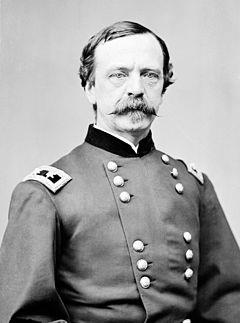
Devil Dan, the Yankee King of Spain

It seems strange that such a person should now be forgotten, for General Daniel Sickles was absurdly popular during the last half of the nineteenth century.  His reputation had just the right mix of sex, madness, and political intrigue that—had he lived today—it might have landed him in his own reality show.  Or, in a prison cell.

Daniel Sickles was born into a wealthy family in New York somewhere between 1819 and 1825—Dan may deliberately have "confused" the dates to appear younger than he actually was.  After college, he studied law under Benjamin Butler, the Attorney General of the United States, and was elected to the New York State Assembly.  Obviously, Dan was destined for great things, if he could only avoid trouble with the ladies.

Unfortunately, Dan couldn’t:  his reputation was that of a scoundrel (albeit, perhaps one with a sense of humor).  He frequented whorehouses, made friends of pimps—even escorting one rather infamous madam through Tammany Hall—and seemed to develop a new love interest almost weekly.  One contemporary compared Dan’s morals to a rotten egg.

Although is not altogether surprising that he seduced the young daughter of the family he lived with, it is surprising that he married the young pregnant girl.  Even though he was more than twice her fifteen years of age, Dan married Teresa Bagioli against the wishes of both their families.  Besides her obvious beauty, it was said that she was worldly beyond her years and could speak five languages. 

Dan became the Corporate Counselor for the City of New York, and helped the city acquire the land that was to become Central Park.  That he might have personally prospered in the selection of this real estate is probably accidental.  Most of what Tammany Hall did was "accidental". 

In 1853, President Pierce sent Sickles to London as Secretary of the legation under then  Ambassador James Buchanan.  Presented to Queen Victoria, he cut something of a dashing image at the Court of Saint James, and evidently he made quite an impression among several of the Queen’s Ladies in Waiting.  Since Teresa was pregnant, he had left her behind in New York.  He did, however, take along to London his friend, the notorious madam and when he introduced her at court, he incorrectly identified her as having the same last name as one of his political rivals.  (This, too, was probably an "accident").

Taking advantage of his rank of Major in the New York Militia, Sickles insisted on wearing his dress uniform—complete with sword—to state occasions.  He even managed to cause a minor international incident when he snubbed Queen Victoria at a ball held on Independence Day.

On his return to Manhattan in 1855, he was elected to Congress.  He and Teresa took residence in a fine house just a pistol shot from the White House.  Almost immediately, there were rumors about Dan’s extra-curricular activities.  Surprisingly, there was soon a rumor about Teresa, as well.

The District Attorney for Washington DC was Barton Scott Key, the son of the prominent lawyer and amateur poet, Francis Scott Key.  Recently widowed, Barton Key was rumored to be the most handsome and eligible bachelor in Washington.  At the inaugural ball of President James Buchanan, Key became enamored with the young beautiful wife of his friend, Dan Sickles.

It was not long, before the flirtation became a serious affair.  Key rented a small, two-story house in the disreputable section of town, where freed Blacks lived—a part of Washington where no one in the upper social circles was likely to frequent.  (Currently, it is the site for the Bureau of Engraving and Printing.)  (At that time, freed Blacks could live in Washington only if they paid a bond, and secured a sponsorship from a White man).  Crime around the capital was so bad, that Congressmen and Senators frequently armed themselves with derringers for safety.

Teresa and Key, arranged a set of signals:  if he was in residence in their love nest, he would hang a piece of white string out the upper window and if she wanted to communicate with him that the coast was clear for a rendezvous, he could see her handkerchief waved from her bedroom window, as he watched with opera glasses from his station on a bench across the street from the Sickles’ house.  This subtlety borders on modern spy craft—no one would suspect any of this…or?

Of course people knew what was going on.  An attractive white woman coming and going—if you’ll pardon the phrase—in the middle of the day, in a bad section of town will attract attention.  Dan heard the rumors, but when confronted, his wife always denied the affair.  But eventually, Dan received an anonymous letter spelling out the details of the affair and he confronted Teresa so forcefully that she not only confessed, but at his insistence, wrote out the all of the sordid details in a sworn affidavit.  (Dan, remember, was an attorney.)

The next day, Barton Key was sitting rather conspicuously on a bench neat the Sickles’ home.  Dan rushed across the street, yelling, “Key, you scoundrel!  You have disgraced my house—you must die!”

Dan fired his Colt revolver, wounding Key, who sought protection behind the trunk of a slender tree.  Reaching into his coat pocket, where he normally carried his derringer, he produced and threw….his opera glasses.  (Never bring binoculars to a gun fight.)  The opera glasses bounced harmlessly off Dan, who once again tried to fire his Colt revolver, but the gun misfired.  Reaching into his pocket, Sickles produced his large bore derringer and shot Key again.  Throwing the derringer into the street, he returned to the Colt revolver and continued to fire at close range at the mortally wounded Key until all the working cylinders had been fired.  Dan dropped his revolver, walked to the home of the Attorney General, and surrendered.

This was not exactly a private affair.  The attack literally took place across the street from the White House in what is today, Lafayette Park.  The street was full of prominent officials who had witnessed the cold blooded murder of the city’s District Attorney by a prominent Congressman.  The legal system should be swift and harsh—if for no other reason than the victim just happened to be the nephew of the Chief Justice of the Supreme Court, Roger Taney.  (Taney is still infamous for his profoundly racist majority opinion in the Dred Scott Case.)

Nothing about this case was anything but weird.  Dan Sickles was incarcerated, but not in prison, but in the warden’s apartment.  For his own protection, he was allowed to keep his Colt revolver.  (Yes, that Colt revolver.)  He received so many visitors, that it was damn near a constant parade.  Congressmen, Senators, judges, and a secretary even brought a note from his friend, the President of the United States.  And the press loved the story.  Before long, the popular version of the story was that Sickles had defended the virtue of all of the women of Washington from the lustful threat of a demon.

At the trial, Sickles defended himself, aided by Edwin Stanton, the future Secretary of War for President Lincoln.  The defense pleaded not guilty by reason of temporary insanity—the first use of this defense in the United States.  Stanton argued that Sickles had been driven insane by his wife's infidelity, and thus was out of his mind when he shot Key.
 
Dan Sickles was acquitted, publicly forgave his wife, and while he tried to stay out of public life for a short time, did not resign his seat in Congress, which he still held when the Civil War started.

Like everything else in his life, Dan’s military career is controversial.  He performed well at recruiting men, he was good at organizing his forces, but his fighting career is sketchy.  When Lincoln recommended his promotion to Major General, he became the only Corps commander in the Union Army who had not graduated from West Point.  While he performed well in some battles, his headquarters was infamous for being a cross between a saloon and a bordello.

Most controversial was his decision at Gettysburg to move his force—without orders—to a position to oppose Confederate General Longstreet, resulting in the near total destruction of the forces under his command.  Criticism of his actions was further complicated by his having received a wound that led to the amputation of his right leg.  While, today, he is the only major general not memorialized on the battlefield with a monument, he did receive the Congressional Medal of Honor in 1897.  (Ironically, in the popular reenactments of the battle at the end of the century, the last two surviving major generals of the battle were Longstreet and Sickles.  Now close friends, they would help each other climb Little Round Top).

After the war, Sickles was sent on several State Department missions.  He secured from Colombia compliance with a treaty that allowed American troops to safely cross Panama.   (A few decades later, Theodore Roosevelt would come up with a much better solution—he simply “took” Panama.)  In 1869, after the death of his wife, Teresa, Sickles was sent to Spain as our Minister with the secret instructions to purchase Cuba.  (McKinley solved that problem a few years later by “taking” Cuba.)

While Sickles was never quite able to buy Cuba, you have to say that our relations with the country improved dramatically.   Queen Isabella II had been deposed in 1868, formally abdicating in 1870.  Her son, Alfonso XII, was restored to the throne in 1874.  During this time, while the royal family took up residence in exile in Paris, they were still quite powerful in Spain, since the monarchy was so strong with the Spanish people that few doubted its eventual restoration.

During this time, Dan Sickles, as the U.S. Minister to Spain, spent most of his time in Paris—usually "with" the queen.    He was so obviously the queen’s lover that the European press frequently referred to Sickles as "The Yankee King of Spain".   While the Queen’s Consort, Francis, the Duke of Cadiz, did not particularly care (openly homosexual, he frequently hinted that none of their children were actually his), the Queen did not like the scandal.

So, Dan Sickles was married again, this time to Carmina Creagh, a member of the Queen’s household and the daughter of Chevalier de Creagh of Madrid, a Spanish Councilor of State.  While they eventually had two children, Dan spent very little time with his wife.  At one point, while they both lived in New York, they maintained two separate households for almost thirty years.

Dan Sickles returned to Congress for one term, but otherwise lived out the rest of his life on his military retirement pay.  Eventually, one of his neighbors was Mark Twain, who once said of the general, “I have been told that Wagner’s music is better than it sounds.  That fits the general’s manner of speech exactly.  His talk is much better than it is...His talk does not sound entertaining, but it is distinctly entertaining."

Twain may have enjoyed the general's conversation, but he used to tire of Sickles' constant talk about his missing leg—he thought that "the general valued his lost leg a way above the one that is left.  I am perfectly sure that if he had to part with either of them, he would part with the one that he has got."

Dan Sickles spent the rest of his life in New York, passing away in May 1914.  He is buried in Arlington Cemetery and while his funeral in New York included a grand parade through Manhattan, his memory today is little more than a footnote in legal books.

Saturday, February 27, 2016

Civil War Coffee

Quick!  Who became President of the United States because of coffee?  You can check your answer a little later.

Andy Jackson did not owe his presidency to coffee, but he was certainly a man who enjoyed an occasional drink—and I don’t mean coffee.  He understood alcohol and what it could do to the men who drank it.  So, it is not all that surprising that in 1832, as President and Commander in Chief of the Army, he ended the daily liquor ration for the troops.  Instead of whiskey, the men were to get coffee—a tradition that lasts to this day.

This simple step probably saved more lives than you think, not just because it lessened risk for—but by no means protected all—intoxicated men with weapons from the occasional accident.  It was the boiling of the liquid that saved the most lives.  The simple process of making hot water helped eliminate some of the dangers of dysentery and cholera, either of which killed more soldiers in the 19th century than bullets.

Without knowing about germ theory, people noticed the healthful quality of a morning cup of coffee.  A US Army field manual from 1861 even included the helpful advice:   “Coffee tastes better if the latrines are dug downstream from an encampment.”

During the Civil War, the standard Northern coffee daily ration was ten pounds of green coffee per 100 men.  A supply sufficient for two to three days was apportioned into small piles, each issued to a single soldier, who would wrap it in paper, oiled cloth, or rubber bag to protect the valuable commodity.    When possible, each man would bring water to a boil in his tin dipper or a special tiny pot called a ‘mucket’ and add enough of the ground coffee to the hot water to make a single cup of coffee.  How much to add was a constant battle between the availability of a coffee ration and the demands of hunger.

According to long established military tradition, there are five grades of coffee; Coffee, Java, Joe, Jamoke, and Carbon Remover.  The bottom two can only be made by true coffee illiterates; tea drinkers, the US Army, and Mormons.  If you are making your coffee in a tin cup, held with baling wire over a camp fire, using pathogen-laden water, darkened with stale coffee and moldy sugar….you should probably make the coffee strong enough to float a horseshoe.  When the coffee was strong enough, a splash of cold water would be added to the pot to settle the grounds to the bottom of the pot and a cup of coffee could be gently poured into a tin cup.

The standard practice when the coffee was ready, was for the soldier to pour a little onto his tin plate to help clean it, dump it out, and then add hardtack to what remained in the cup.  These brick-hard crackers could not be eaten until moistened in something, and submerging them in hot coffee was probably as beneficial to the soldier’s health as it was to his teeth.  There was a reason the soldiers called hardtack ‘worm castles’.

Try to visualize the scene.  During the war, wherever the Army of the Potomac stopped for the night, it was suddenly the second largest town in the Confederacy.  Hundreds of tiny fires would be lit from scavenged sticks and repurposed fence posts.  Then a strange buzzing noise would fill the air as shared coffee grinders were put to work for the evening meal.

During the Civil War, the army tried to simplify the distribution of coffee by dispensing a form of ‘instant coffee that was a dehydrated essence of coffee and sugar that looked and tasted like petroleum.  Distributed in quart cans, a teaspoon mixed with hot water produced a cup of ‘instant coffee’ that no soldier would touch.   The army rather quickly withdrew this product from distribution.
Coffee was absolutely necessary to the men.  A recent study of Civil War diaries revealed that solders mentioned coffee more often than ‘rifle’, ‘cannon’, or ‘bullet’. 

By the end of the war, the average Union soldier consumed 36 pounds of it a year!  Most of it was issued green, with the soldiers roasting and grinding the beans themselves, using makeshift tools and improvised methods.  One rifle was even manufactured with a coffee grinder built into the stock!

One Union general even timed his army’s attacks based on when his men had consumed their morning coffee.  As General Benjamin Butler assured another general, “If your men get their coffee early in the morning you can hold.”

In the South, things were not quite so cheery.  After President Lincoln ordered a naval blockade of Southern ports, coffee and tea became increasingly difficult to obtain and the price per pound skyrocketed.  Starting at about $3.00 a pound, by the close of the war, coffee was almost impossible to obtain even at the escalated price of $60 per pound.

This shortage led to the South's inventing a variety of what came to be called ‘Lincoln Coffee’.  The list of coffee substitutes is almost endless.  If it was green and could be grown, then somebody, somewhere used it to make "coffee" by drying, roasting, grinding, and percolating it.  Peanuts, barley, okra seeds, acorns, barley, beans, beets, bran, chestnuts, chicory, corn meal, cotton seeds, dandelion, sweet potatoes, peas, persimmons, rice, rye sorghum molasses, sugar cane seeds, watermelon seeds and wheat berries were just a few of the things tried.  Local newspapers would even publish recipes on how to brew something that just might—kind of—look like coffee.  The most desperate for coffee have to have been the Union prisoners of war in Andersonville, who tried to brew coffee with scorched slivers of wood.

It is safe to say that none of this tasted like coffee unless you had the type of imagination that was brought on by severe deprivation.  A few of these recipes would surface again in the Great Depression of the 1930’s, but today the reminder of this ersatz coffee can be found in Louisiana where chicory is still routinely added to coffee.

And the president who owes his start to coffee?  During the Battle of Antietam, a nineteen year-old Sergeant McKinley was mentioned in dispatches when he braved enemy fire by taking coffee and food to the men at the front line.  His bravery under fire earned him the personal friendship of Rutherford B. Hayes and a promotion to the rank of Lieutenant. 

For decades after the war, every politician running for office used his war record, a practice known as 'waving the bloody flag'. The last veteran of the Civil War to live in the White House, McKinley ended the war with the rank of Brevet Major, and for the next thirty years campaigned on the basis of a 'bloody coffee cup'.  If you visit Antietam, there is a monument—thirty-three feet tall—to McKinley and his coffee run.  

Saturday, February 20, 2016

Papel Picado

Papel Picado, or ‘perforated paper’ is a Mexican handcraft or folk art dating back centuries.  Intricate designs are cut into multi-colored tissue paper using chisels and scissors.  These sheets are hung from strings to form long banners that can hang from houses, across streets, and decorate the walls of rooms.

Frankly, these are one of those things that everyone in the southwest frequently sees, rarely actually notices, and never has any idea that it actually has a name—much less that its form is the result of influences from around the world.

Present at almost every form of celebration such as baptisms, weddings, and funerals, they can also be found during holidays—especially during the “Days of the Dead”, Christmas, and Independence Day.

An interesting element of this art is the very ephemeral nature of the materials used.  Usually, the art is left to the mercy of the elements and disintegrates in only a few weeks, so there are very few historic examples of this art form.  This aggravates the problem of understanding the origins of this Mexican tradition.

Long before the Spanish arrived, the Aztecs had a tradition of making a form of paper called amatl from mulberry and fig bark.  The Aztecs used huge amounts of this paper and the surrounding villages and conquered tribes paid almost half a million sheets a year to the Aztecs as a form of bribe.  (Those who fell behind in paying their taxes got a one-way trip up the side of a ceremonial pyramid.)

Besides using the amatl for writing and painting, the Aztecs used obsidian knives to cut the paper to produce silhouettes, primarily of a ceremonial nature, and included images of the numerous Aztec gods and goddesses (a practice that was discouraged by their Christian conquerors).  While few examples of the Aztec work survive today, amatl (now usually called amate) made in the traditional method is making something of a comeback today and is prized by artists.   I recently admired, but could not afford, a reproduction volume of Aztec codices painted on amate.

The traditional form of the art changed with the arrival of the Spanish.  China had invented the process of paper making in 105 AD, and by the sixth century, they had developed their own artistic style of cutting paper.  Called jianzhi (cut paper), both the new art form and the method of making paper spread westward across Asia along trade routes.  By 1150 AD, the Moors began making paper in newly conquered Spain.  The Moors, however would not allow graven images, so the art work was limited to geometric designs, and calligraphy expressing scriptures.

Both the knowledge of paper production, and the form of artwork associated with it spread rapidly across Europe.  In Germany it was called asscherenschnitte, in Poland, it was known as wycinanki, and in France it became silhouettes.   And when the Spanish came to New Spain (Mexico), they brought the tradition with them.  The Spanish introduced a new culture, with a different language, religion, tools, and art traditions with them.

In Mexico, artisans abandoned the obsidian blades, and adopted metal chisels that could cut through multiple layers of paper accurately.  Today’s artists may use dozens of chisels, called fierritos, each with a different shape.  They work the paper, much like a leather worker uses his tools, to create intricate designs in the paper.

Shortly after the Spanish conquered Mexico, they took possession of the Philippines.  The Black Galleon of Manila, an annual convoy of goods from the Philippines, brought the merchandise from the Far East to Mexico, and among the silks and porcelain from China, was a new form of fine paper that was often used to wrap and protect the fine porcelain.  Called papel de China (Chinese paper), it proved a perfect medium for carving, for as many as 40 pages could be duplicated at one time.

Note.  This was also the likely origin of the luminarias (the term used in the south half of New Mexico), or farolitos (the term used in the north half of New Mexico) that are used to decorate walkways in front of southwestern homes at Christmas time.  It was probably Chinese paper lanterns that inspired the sand-filled paper bags that hold candles.  The tradition continues to evolve: lately the Spanglish term for these lights has morphed into bag-a-litos (the term used by pendejos gringos) and occasionally the new artificial plastic bags equipped with electric lights are called ‘fake-a-litos’ (the term used by idiotas). 

Today, papel picado is still very popular.  . Much of the papel picado available in today's folk art market comes from the village of San Salvador Huixcolotla, Puebla, which lies southeast of Mexico City.  It is no longer necessary to go to the market to purchase it, since custom banners of any length, proclaiming any message, can be purchased on the internet.

Distressingly, just as the purchase method has changed, the art form has morphed a little, too.  You no longer have to purchase your banners on flimsy tissue paper that will vanish with the next rain or spring wind.  Today, you can buy papel picado cut from plastic sheets that hang from nylon strings.  I have no doubt that somewhere, someone has replaced the sharpened chisels with laser printers that can cut out computer-generated art work.  And the modern form of this “art” will probably last in our landfills far longer than the people who produced it.  The Aztecs could never have begun to imagine that!


Saturday, February 13, 2016

That Sinking Feeling

Alfred Gwynne Vanderbilt stood at the railing of the stricken ship, fully aware that it had only minutes left to stay afloat.  The heir to the massive Vanderbilt fortune was certain that when it finally did sink, he would die like most of the other passengers gathered alongside him on the crowded, sloping deck.

Just a few minutes earlier, he had believed that he might have a slim chance of survival, because he had put on his life preserver as soon as the ship's steward had advised him to do so.   Both he and Ronald Denyer, his valet, had gathered on the boat deck to wait while the women and children boarded the lifeboats first.

As one of the wealthiest men aboard—indeed, one of the wealthiest men in the world—he was well-known and his face was familiar to most of the first-class passengers gathered around him.  Perhaps that is why a young woman, Alice Middleton, had asked him to help her, and the young child she was holding, to safety.  The poor woman had no life preserver, so Vanderbilt tried to find a crewman who might locate a spare, but every available member of the ship's crew seemed to be struggling in the attempt to lower one of the remaining lifeboats.

With no other recourse (and as dozens of passengers watched), the gallant multi-millionaire removed his own life vest and carefully tied it around the young woman's shoulders as she tearfully clutched the infant to her breast.

Vanderbilt knew that this act almost certainly guaranteed his own death, since--despite enjoying an international reputation as a sportsman--he did not know how to swim.  As the ship's deck continued to tilt, it was increasingly obvious that not all of the ship's lifeboats could be launched before the ship foundered.

As Vanderbilt stood beside his valet, with his eyes fixed on the impossibly cold water he would soon be forced to enter, he had only a few minutes left for personal reflection.  He had followed the news about the building of the RMS Titanic with great interest.  After all, his family had been in the shipping business for generations and--with both business and personal interests on both sides of the Atlantic--he made the crossing several times a year.

Everything he had heard about the Titanic had impressed him:  the ship's size, speed, and opulent grandeur were deliberately planned to compete with the rival Cunard Line's RMS Lusitania.  His friend, J. P. Morgan held controlling interest in the International Maritime Marine which controlled the White Star Line, which owned the Titanic.  Morgan had convinced him to book passage on the great ship's maiden voyage.  The men had each reserved passage in the largest suites, each of which came with such amenities as custom cigar holders and a private promenade deck.

But shortly before the ship left port, J. P. Morgan decided to stay in France to enjoy the sulfur baths and did not sail on the Titanic.  This decision quite literally saved his life.

Alfred Gwynne Vanderbilt had looked forward to the crossing, but before the ship could set sail, his mother had begun having premonitions and nightmares about his drowning at sea.  Though the ship was billed as “unsinkable”, he finally decided to please his mother and—at the last possible moment—canceled his reservation, too.  His uncle—who was to have accompanied him—canceled as well, but could not claim his luggage before the great ship sailed.

This decision not to sail on the Titanic came so late that Alfred's name remained on the passenger manifest, so that when the first newspaper reports of the ship's sinking were printed, his name was listed among the missing.  This caused considerable grief to his family and friends for several days until telegrams arrived, reassuring them of his safety.

Now, three years later, Vanderbilt knew that his family would not be spared the anguish a second time, for he was sure to be listed (correctly, this time) among the victims of the RMS Lusitania's sinking.  On the afternoon of May 7, 1915, a German submarine fired a torpedo into the ship—which sank in less than 20 minutes—killing 1,198 of the 1,959 passengers aboard.  Sinking by the bow and listing to starboard, the ship had been able to launch only six of her 48 lifeboats before foundering.

When word of the ship's sinking reached Alfred's wife, Margaret Vanderbilt, she refused to accept the news of Alfred's death.  Locking herself in her suite at the Vanderbilt Hotel in New York City, she stated, "I will not believe Alfred is dead until I get conclusive proof."  However, as the days went on and no good news reached her, she eventually had to accept that Alfred was among the lost.  

Even though the Vanderbilt family offered a $5,000 reward for its recovery (a princely sum at the time), his body was never found.  

And I bet you thought this was another Titanic story.

Saturday, February 6, 2016

Looks Like a Word

Everyone is familiar with the concept of onomatopoeia—word that is spelled like it sounds.  “Splat” is a perfect example.  This word does not owe its etymology to the Greeks or Romans:  it probably came from some poor writer's dropping his lunch. 

The word “onomatopoeia” on the other hand, is derived from the Greek words for “to make” and “name”—which probably isn’t fair, as the word for onomatopoeia should, by all rights, be an onomatopoeia. 

Most of these words are culturally based, which is why ducks go “wang wang” in China and clocks go “di dah” in Japan.  Cows the world over make some kind of mooing noise, except in Hungary where they go “bu”.  I wonder what sounds Hungarian ghosts make?

These words are often described as a form of poetry.  Certainly, Carl Sandburg thought so—His poem Jazz Fantasia is often cited as the best examples of onomatopoeia in literature:

Drum on your drums, batter on your banjoes,
sob on the long cool winding saxophones.
Go to it, O jazzmen.

Sling your knuckles on the bottoms of the happy
tin pans, let your trombones ooze, and go husha-
husha-hush with the slippery sand-paper.

George Eastman was so fond of the sound a camera shutter made—“Kodak!”—that he used the term for his new photography company.  Advertisers have followed his example ever since.  Everyone knows what goes “Plop! Plop! Fizz! Fizz!” and there is probably not a person on the planet who does not know the sound Rice Krispies make in milk.

Even government has gotten into the act.  Several countries have used sounds to promote the use of automobile seat belts.  In England, the campaign was “Clunk, Click, Every Trip”, in Australia, it was “Click, Clack, Front And Back”, and in the U.S., it was “Click It Or Ticket”. 

Only one business loved these words more than advertisers—the comic book industry.  Bif!  Pow!  Ka-blooey!  Batman practically lived in a monosyllabic world (if for no other reason than the rather short words would fit into a single cartoon panel while expressing both motion and emotion).  The writers quickly learned that the use of onomatopoeia intensified the action of a scene.

In 2002, a writer for DC Comics capitalized on the use of such words by creating a new supervillain by the name of "Onomatopoeia".  In his duels with the Green Arrow and Batman, his dialogue—I bet you are way ahead of me—consisted of single descriptive words.  In one memorable scene, as he shoots the Green Arrow, he softly says:  “Bang!”  While it was meant to be something of an inside joke in the world of graphic novels, the villain was popular with the more literate readers.

Roy Lichtenstein took the onomatopoeia into the world of art in 1963 with his ground breaking painting “Whaam!”  Inspired by a 1962 issue of DC Comics' All-American Men of War, it is probably his most famous work and shows an American fighter plane firing a rocket into an exploding enemy plane.  (Actually, of course, this piece was fairly derivative of his 1962 painting “Blam” but since the name of that painting used conventional spelling and lacked the all-important exclamation mark, the art world ignored it.)

All of the above are referring to words that are spelled to copy a sound, but as far as I can determine (that means I googled it for about two minutes) there is no noun for a word that looks like what it is describing.  Since the task falls to me, I will do it properly, resorting once again to Greek word roots.  This gives us onomatomalosa, or ‘resemble name’.

I will be the first to admit that onomatomalosa will be a concept that will be used a little less frequently than onomatopoeia.  Actually, after extensive research (I drank two beers) I was only able to come up with three such words.

The first is ‘Bed’.  Okay, I admit that it would be better if we spelled the word as ‘Beeeeed’, but you have to work with you’ve got.  Obviously, the word looks like a bed.

The second word is ‘eYe’.  Yes, I played around with the capitalization a little, but it still works.  And somehow, when I look at the word, it makes me think of owls—smart owls wearing glasses.

I’ve saved the best for last.  ‘Boob’ is a triple onomatomalosa.  Let’s break the word down.  ‘B’ is a top view, ‘oo’ is obviously a front view, and ‘b’ is a side view.

There have to be other such words.  Feel free to add to the list in the comment section below.