Saturday, October 17, 2015

Reformatting Formats


This has been one of those weeks at Enema U, I have spent more time working with people with computer problems than with my students.  I should complain, but Enema U actually pays me more to solve piddling little computer problems than to teach history.  Go figure!
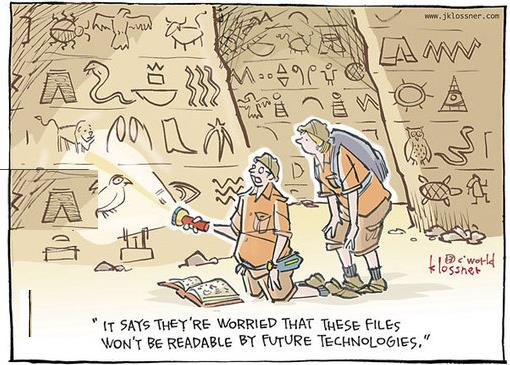
By coincidence, most of the problems this week concerned trying to recover old files from long-dead computers.  Even after the dead had been resurrected, it turned out most of the files were in word processing programs only slightly more advanced than using pointed sticks in clay tablets. 

No one ever calls the lab and says, "Hey, I have this old file, so worthless that I haven't read it since disco, and God knows I never bothered to back it up or even print out a copy, but if you have time, it might be fun to look at it.  Can you help me?"

Nope.

It's always, "Oh my God!  It's an emergency.  My only copy of my manuscript is gonna be lost unless you can help me!  I don't remember what the file was called, and I'm not sure where I saved it on this ancient hard drive, but YOU HAVE TO HELP ME!"
I personally have saved the Great American Novel at least a dozen times.  Not that any of them ever got into print.
Safe copies of one’s work have always been a problem: it is not something new to the digital age.  Even with printed records, how many copies were enough?  Libraries burn, copies can get lost, and paper is fragile.  If paper is your only storage medium, then nothing is permanent.  Most of the books printed in the late 19th and early 20th centuries were printed on paper with such a high acid content, that nowadays, libraries routinely find that precious volumes have turned into faded confetti.  Even today, some publishers print their hardbacks on such poor quality paper that the expected lifetime of the volumes is less than 20 years.
For a guy who is still angry at the Romans' burning of the library at Alexandria, this situation is entirely unacceptable.  Some of the greatest mystery stories ever were those of The Thinking Machine by Jacques Futrelle.  But none of us will ever be able to read all of them, since several unpublished manuscripts went down with the author when the Titanic sank.

You would think that computers would provide some form of remedy, but they actually have made the problem far worse.  For years, every word processing program went out of its way to make sure that every document saved would be compatible with every other word processing format.  Eventually, public pressure created a need for some forms of open format:  ASCII, RTF, and PDF files being the most popular.

NOTE.  When I just happened to mention in passing to my wife, The Doc, the universal knowledge of ASCII (American Standard Code for Information Interchange) she gave me a blank look.  In the twenty-first century, how can anyone NOT understand ASCII?  Incredulous, I asked her, "C'mon!  What is ASCII 65?" 
She didn't know!  Wives are weird.
The fact that some documents could be saved in an almost universal format did not solve the problems, since every computer used a different storage system to save the file.   Simply put, a disk from one computer was unreadable to a computer from a rival manufacturer (sometimes, it could not even be transferred between two models of computer from the same manufacturer--how's THAT for planned obsolescence?).  And it has always been this way.
In 1976, manufacturers and programmers met in Kansas City to agree on a standard format for storing data on cassette tapes.  (Yes, before the floppy disk drive became affordable, early computers stored data on cassette tapes...Badly.)  Everyone at the meeting quickly agreed on a standard--the Kansas City Standard.  And then almost all of them went home and developed their own proprietary standards incompatible with the new standard, in the desire to lock in their own customer bases.

At the same time, the hardware itself was changing constantly.  Computer cards were replaced by paper tape, which was replaced by cassette tape, which was in turn replaced by floppy disks that came in a bewildering assortment of both sizes and capacities.  Which holds more data, a single-sided, single formatted 10" diskette or a double-sided, hard-sectored 5.25" inch disk?   Unfortunately, none of them can be relied on to be readable after resting in a file cabinet for a decade.

I once had a lawyer promise to pay me any sum of money I wished if I could resurrect data stored on Mag Cards from a IBM typewriter system from the 1970's.  And for the amount of work it took me, I was still underpaid.  Even IBM didn't have one of those antique systems in its museum.

Zip drives, CD drives, DVD (single and dual layer), Thumb drives, and Blue-ray disks...while the storage capacity of the new drives keeps increasing dramatically, there is almost no backward compatibility.  (And almost no one remembers to copy data from old devices to the new devices).  There is no such thing as permanent storage.  Whether we like it or not, every day the world loses the last copy of something.
The temporary nature of our collected knowledge reminds me of the old Roman practice of the the triumphal parade of a victorious general.  As he guided his chariot through the crowds of cheering citizens, a slave stood on the rear of the chariot, holding a laurel wreath over the general's head while gently whisperer a reminder.

"All glory is fleeting."

Saturday, October 10, 2015

I Hanker to Hunker


It has rained enough this week that locals are checking their driver’s licenses to see if they still live in New Mexico.  Normally, around here, it is so dry and dusty the children adopt tumbleweeds as pets and the Spanish Doves build their nests out of barbed wire.  Dry is one of the things we do well in New Mexico. 
 
All this rain is creating a couple of problems with the rock walls surrounding my house:  some of the formerly bone-dry mortar is leaching out of the walls and one or two of them are starting to look a little lazy.  (Rock walls are something else New Mexico does well.  This is a great place to build with rock and adobe because it never rains—at least, until this week.)
 
Suddenly, I have to patch my own rock walls and masonry is not in my skill set.  I can fly a hot air balloon, I know which end of a hammer fits the hand, and I can even bake you a fair loaf of cheese bread—but working with concrete is a pain in the ass.  (Come to think of it, most of the men I know are pretty good cooks.  Restaurants, unfortunately, are not one of the things Southern New Mexico does well.  The local notion of a seven course meal is a six-pack of Corona beer and a burrito.)
 
I miss my rock wall guy.  He would know how to patch the mortar, replace a few missing stones, and while he was doing it, I could get him to build a few new walls.   José built all the sturdy rock walls around my house, and he did it fast and incredibly cheaply.  He was by far the best rock guy I have ever met, and at the bargain prices he charged, I could always find a new wall project. 

Not that there weren’t a few problems working with José.  First off….well, let’s just say he was of questionable citizenship.  Donald Trump would either deport him or have him rebuild Trump Tower in stone. 
It was not even remotely possible that José was from New Mexico.  Quite a few people born locally either learn English as a second language, or not infrequently, never learn it.  In José’s case, he could speak neither English nor Spanish.  José spoke only a dialect of Nahuatl. 
For those of you who have not studied Pre-Columbian Mexican History in my class (and you are welcome—Tuesdays and Thursdays at 10:20), Nahuatl is the language of the Aztecs, and roughly 1.5 million people still use it—almost all of whom live in Central and Southern Mexico.  New Mexico has 19 pueblos and 3 reservations, but none of them are for the Aztecs.  While a lot of Spanish words have made their way into the Nahuatl vocabulary (and a lot of the really good Spanish profanity has its roots in Nahuatl) it is not the same language.
Luckily, whenever José came to my house to build a new wall, he brought his grandson with him.  His grandson, about 7, had a fair working vocabulary in Spanish, Nahuatl, and English.  His skill in English was about even—poor—with my skill in Spanish (minus the interesting profanity).  So, every time I needed a new rock wall, the three of us would gather in my front yard and enact our own little private version of the UN.  There was a lot of waving of hands and hunkering and drawing in the dirt. 

Since my prodigious hate mail indicates that my readership includes a large number of Yankees, I should explain about hunkering and drawing in the dirt.  In Texas, this is an art form as respected as fiddle playing, bass fishing, or playing dominoes. 

The hunker and draw is a skill honed over eons of time that got its start with primitive man who hunkered down around his fire and drew crude figures in the dirt as he lied about that day’s hunt.  Even today, a good hunker damn near requires a stick in the hand to draw in the dirt.  If two Texans spend more than thirty seconds discussing a deer hunt, they’ll both get down on their haunches and start to draw in the dirt.

After thousands of years of technological improvement, the only real improvement in education is that we have exchanged ‘the hunker and draw’ for PowerPoint.  Socrates described a classroom as a log with a teacher on one end and a student on the other.  If Socrates had been a Texan, he’d have held school without the log.

One of the built-in advantages of hunker and draw is that there is an automatic time limit.  After about half an hour, the newcomer will need a crane to stand up, and as his legs develop a Charley Horse that could run the Kentucky Derby, he may find himself readily consenting to proposals that he might find objectionable standing upright.  If the United Nations building had been erected in Fort Worth, by now we would have achieved world peace.

I would try to get my department head to hold the next faculty meeting outside so we could all gather under a tree for a good hunker, but the damn Yankee, bless his heart, probably can’t tell the difference between a good hunker and a squat.

Even with the best of dirt drawings, communication was difficult.  There is only so much information that you can pass through the vocabulary of a 7 year old.  I learned that the word rock—piedra in Spanish—is teti in Nahuatl.  And flat stone—piedra plana in Spanish—is tepatiachtli in Nahuatl.  Don’t try to pronounce that, it will make your throat hurt worse than speaking German.  (That will probably piss off Professor Grumbles, the German professor.  But, maybe he won’t read this.  He recently retired and opened a Bavarian bistro he calls the Wurst Bar.)

Occasionally, mistakes were discovered in our design.  If you drive by my house, you will notice that the front wall has a definite slant as it runs east.  I have no idea why, but maybe the “blueprints” needed a sharper stick.  I blame it on the 7 year old—it’s hard to teach construction to children.
That front wall was the last job José did for me, since he seems to have vanished.  I haven’t been able to find him for years, and I have really tried.  When he did that last job for me, he laboriously asked—through our translator—if he could deliver the necessary rocks in the cool of the evening, and then start the job the next day.  Naturally, I agreed to the plan.

That night, when I went to bed, the rocks had not been delivered.  I wasn’t particularly worried as doing jobs on schedule is another thing that New Mexico doesn’t do particularly well.  I was certain that in a day or two, José would finish the job. 

The next morning, I was surprised to see a mountain of stone in front of my house.  (So were my neighbors, for José had stacked them in the street, not in my yard!)  How he had managed to put so many large rocks in front of my house without waking me is still a mystery.  By the time I left for work, José had arrived and happily begun assembly of my new wall.

When I arrived at Enema U, there was something of a traffic jam in front of the new Sports Chalet, still under construction, at the end of the football field.  It looked like every policeman on campus was gathered around where they were building a new….rock….wall….around….the parking lot.

Suddenly, I understood how José could build the cheapest rock walls in town.  I have no idea if this had anything to do with his sudden disappearance. 
I think of José every time I drive by the Enema U stadium.  I hope he comes back to town before they finish building the new art building.

Saturday, October 3, 2015

The Door

Previously, I have written about the old Jack Tar Hotel in Galveston, which unfortunately isn't there anymore. As far as I know, the largest remaining piece of that hotel is a single weathered brick sitting on a shelf in a bookcase in my office.  Several hurricanes ate the rest of the old hotel, taking a bite or two from me in the process.

This is just about the end of the hurricane season, so I have been thinking about the old hotel lately.  Every hurricane gnawed at the hotel (in some cases the damage was spectacular), but even the smallest tropical depression brought wind damage and flooding--this is the inevitable fate of anything built directly on a beach.  An oceanographer once told me that the ocean eventually either buries or washes away everything it touches, and a little of both eventually destroyed the hotel.

Not all the hotel's destruction was caused by nature, however:  It suffered through a few man-made storms, too.  Some of the "storm damage" was caused by the exuberant application of the law by the off-duty police officers I employed as hotel security.  Someday, I really should record a few stories about "Too Cold" Taylor and "Colonel Klink”.  (I'll have to check on the statute of limitations first).

The worst man-made storm damage, however, was caused by conventioneers.  The only safe way to attend a convention of the Telephone Workers of America is from inside an Abrams battle tank--And keep the hatch firmly dogged!  It still mystifies me how such a group of harmless-looking people could hold such a wild drunken convention and it was simply amazing how many of them ended up in either the county hospital or the county jail! 

One convention that stands out in my memory is a convention that started out fairly mildly, anyway.  The Mattress Tax Tag Collectors of Texas (the name has been changed to protect the guilty) was the kind of mild-mannered group that could be counted on to arrive with a dirty t-shirt and a five dollar bill...and by the time the convention was over and they had left the island, they wouldn't have changed either one.

So it was something of a surprise when the front desk got a call about 3:00 AM, from a guest in one of the of the lanai rooms, complaining about the noise from a room occupied by one of the Mattress Tax Tag Collectors.. 

It was standard policy at the hotel that in the advent of anything really weird, the front desk was to call a manager instead of security, who would then make the decision about whether to call security.

The lanai rooms were strange, two-story bungalows, scattered around the pool; each one was comprised of only two rooms, with the upper room accessed by a flight of stairs.  This shows the age of the hotel:  not only would this kind of room fail to meet current ADA compliance, but cleaning these rooms would be far too labor-intensive for today's wages.

When I got to the room in question, sure enough, there were loud sounds of a man's moaning and sighing.  I couldn't make out all the words, but I could occasionally hear what sounded like someone saying, "Help!  Help me!"

When no one answered my knock on the door, I used my passkey let myself into the room.  The television was on, the room was obviously occupied, no one was in sight, but there was loud moaning coming from the bathroom.

As I moved into the bathroom, I found the source:  A very large--and very naked--man was lying on the floor, covered in splintered pieces of wood, lying half across what had once been a sliding pocket door separating the shower from the rest of the bathroom.  His badly scraped and slightly bleeding body was half in one room, and half in the other, and the remains of the door had a large man-shaped hole right through it.

Note.  When Rene Magritte painted the picture to the right, I doubt that he had this use in mind, but it did sort of look like this.

The man was all but unconscious and incoherent, and it took almost an hour to get the poor man to calm down, to stop crying, to remove most of the tiny splinters of wood, to get him covered with a towel, and to be relaxed enough to tell me what had happened.  For the record, there is an awful lot of naked on a large panicky, semi-conscious, naked, (Did I already mention that he was NAKED?) man!

The story unfolded like this:  Despite being somewhat claustrophobic, and alone, the guest had locked the door while taking a shower, but when he tried to unlock the door, it had become jammed.  Before long, according to him, he had "run out of air", had begun choking, and had passed out.  The next thing he knew, I was helping him up and he had absolutely no memory of crashing through the door.

Now, this had been a standard pocket door that slid in and out of the wall.  There was no way it could actually jam:  the latch could be flipped open with a hard stare, so it was rather obvious that the man had just freaked out and in a blind panic had simply crashed through the door.

Eventually, I got the man reoriented and calmed down, and with the help of a bellboy, moved him to another lanai room.  I wasn't too worried about the destroyed door since maintenance could replace it the next day, then housekeeping could vacuum up the remaining wood splinters, and the room would be ready for occupancy the next night.   I wasn’t even going to try and get the guest to pay for the damages, I figured the poor guy had suffered enough embarrassment.

The next morning, as I was making the rounds of the hotel, I passed the room with the destroyed door and saw a note taped on the front door.  Curious, I walked over and read it:

"Jerry, I've moved to 233.  I had a little trouble with the bathroom door in this room.  I had to get tough and use karate on it.  Steve."
 

Saturday, September 26, 2015

You Can Hang Your Hat on It

It seems that Enema U is not the only university run by lemmings who regularly manufacture mountains of fear from molehills of facts.  The President of the University of Delaware has declared a campus emergency—someone left rope nooses hanging from trees. 

(What is the proper plural collective noun for a noose?  Nooses sounds absurd.  Say it out loud and you'll see what I mean.  It is absolutely impossible to say 'nooses' ten times as fast as you can.)

"We will not tolerate this hate crime!" thundered President Taggert.  "We must all stand together against intolerance."

This statement was probably the very first clue that something was wrong.  First, when someone says, "We should all stand together," you should immediately sit down firmly on your wallet.  A contrarian by nature, I firmly believe the wisdom of the masses is a pernicious falsehood on a scale that would intimidate organized religion.  If the collective opinions of the great unwashed were valid, then the finest newspaper in the world would be National Enquirer, the finest beer would be Bud Light, and Congress would deserve to be reelected.

Always run in the opposite direction of the crowd:  If nothing else, you will avoid traffic jams.

Second, can we all just back off a little on the "hate speech"/"hate crime" labels?  There is no right to be protected from being offended—even deeply offended.  Inoffensive speech does not need protection.  You can go to the most regulated and controlled areas of the world—even San Francisco—and praise the local governmental leaders and no one will bother you.  If you do not protect offensive speech—even hateful speech—you are not protecting any speech at all.

The campus hate crime was discovered just hours after a university sponsored protest by the Black Lives Matter group had ended on campus.  This led several students to speculate on the school's website that the nooses (nuces?) were an obvious reference to Southern Jim Crow laws and KKK lynchings.

Sure enough, shortly after President Taggert went on television denouncing the hate crime,  and shortly after the campus police announced they were launching an investigation (this probably meant questioning every student from Mississippi), it was determined that the nooses (Neesi?  Noosi?) were actually the remains of paper lanterns that had gotten a little wet in the rain.  To be fair, it was a hate-filled rain that came up from the south.  And the paper lanterns were made in Southern China.

Why had so many people looked at the remains of wet paper lanterns and leaped to the wild conclusion about racial hate crimes?

This kind of reminds me of the Great Satanic Site in New Mexico.  This is not something tourists will find on the map, even though it is still there. 

It was 1990, and a utility worker stumbled across a large geometric pattern of old tires, laid out in the desert scrub.  The design, almost 500 feet on each side, included three hexagrams, each with a seven tire dot in the center.  The three hexagrams were connected by five lines of tires—altogether, the design used over 450 tires!

A local police officer, who lectured to area high schools about the seductive dangers of Satanism, warned that the area was obviously in use by local practitioners of witchcraft.  "I'd stay away from the area if any people are around," he said to reporters.  "They'll hurt you."

The Associated Press interviewed several experts.  An expert on symbolism agreed that the symbol was connected to witchcraft, and added that it was obviously connected to a moon cult.  A promoter of psychic affairs testified that the steel-belted desert pattern was "a powerful and spiritual symbol."

By this point, TireHenge had been on the front pages of the local papers for almost a week and featured such details as aerial photographs—and the rather grisly discovery of mounds of chicken bones:  the obvious result of ritualistic sacrifices!

Just as the site was becoming the subject of sermons by local pastors, a large number of rather sheepish men—most of them very prominent in civic and social affairs—stepped forward and admitted responsibility for the design.  The design was the layout for a three-way soccer match.  (This is in NO WAY connected to what I wrote about two weeks ago!)

The first game was—I swear!  I'm not making this up!—the Albuquerque Police Department, the Fire Department, and the Parks Department.  The mayor was one of the players.

When asked why it took them so long to come forward, one of the players said, "From what was being printed, we didn't recognize ourselves."

This is exactly the point:  Any act, speech, or behavior can be labeled as evil, deviant, or hate-filled by someone else—someone who is looking for evil in it.  If we allow those in power to label our actions, then it won't take long for the politically incorrect speech—the uncomfortable speech—to equal a "hate crime".  Label something as hate, racism, or prejudice and even those involved won't recognize themselves.

Oh, yes!—and those chicken bones?  They came from that well-known practitioner of the Dark Arts—Colonel Sanders.

Saturday, September 19, 2015

One in a Thousand

The American Civil War occurred at an unfortunate point in technological development: quite simply, we had just gotten very good at killing each other. 

In the first few battles, generals were shocked by the large number of casualties—and those who were wounded had devastating wounds.  This new lethality was the result of recent improvements in rifled barrels, consistently performing gunpowder, and bullet designs.  Suddenly, the average rifleman could reliably kill at 400 yards, reload quickly and do it again.

This was the dawn of the Industrial Revolution and improved technology would make this the deadliest war in American history.  Railroads, steamships, improved metallurgy, better metal casting—all of these contributed to making the war a bloodbath.

Even so, it could have been worse:  the war stimulated innovation and rewarded creativity, particularly in the field of weapons, which improved dramatically. 
 
Note:  It is a sad commentary on the human race that we show our best creativity while trying to murder each other.  Look, for example, at the Second World War:  at the start, we were flying fabric-covered biplanes, but by the end of the war, sleek metallic darts were creeping close to the speed of sound, powered by jet and rocket motors.  If you were to chart the progress of wartime technology (and had the war lasted another ten years), the Big Red One would have established a beachhead on the moon.

 
The casualties of the Civil War could have climbed dramatically if overly conservative generals had adopted repeating rifles when they had the chance.  Two rifles in particular—the Spencer and the Henry—could have dramatically changed the course of the war if they had been widely adopted.  (I have already written about the Spencer, Lincoln's favorite rifle.)

The Henry is a 16-shot, lever-action rifle that utilizes the (then) new metallic cartridges that were so popular with the soldiers.  Operating the lever ejects the spent cartridge casing, loads a new round, and cocks the weapon's hammer so quickly and smoothly that in the hands of an experienced marksman, the rifle sounds like a slow-firing machine gun.  Impervious to weather, easy to load, and rapid-firing, the rifles, while more expensive than the commonly used Springfield muskets, were a dramatic improvement in technology and lethality when introduced.

Despite the proven effectiveness of the rifle, the Federal Ordnance Department purchased only 1,731 Henry rifles, but thousands more were sold directly to the men.  Over 200 men in the Illinois 7th, dissatisfied with the single-shot rifles they had been issued, purchased their own Henry rifles, despite the astronomical cost of $50 per rifle. 

It wasn't long before the rifle was known in the south as "that tarnation Yankee rifle they load on Sunday and shoot all week."

Ironically, the very companies that had profited from the war, went bankrupt because of the peace that followed it.  The federal government no longer had a need for so many weapons, and sold off the surplus arms—including the Spencer and Henry lever action rifles—for as little as $2 each.  Effectively, the arms companies were priced out of the market by their former best customer, who was selling their own products below cost.

Oliver Winchester was a businessman who had become rich manufacturing and selling shirts, and had used some of his earnings to invest in industries manufacturing war goods for the government.  When the firearms companies began failing, Winchester bought up the company manufacturing the Henry and renamed it the Winchester Repeating Arms Company.  Within a short time, he also bought the rights to the Spencer rifle. 

By 1866, a new improved version of the rifle had been produced, the Winchester 1866, commonly called the "Yellow Boy" because of the brass receiver.  This rifle had two important improvements;  a wooden forearm was added (the previous rifles were painfully hot to hold after a few rounds were fired) and the tubular magazine under the barrel was sealed and a loading gate was added to the receiver, facilitating reloading.

In the years following the Civil War, two events changed the Winchester:  the first was the rise of the metallic cartridge—the day of the paper cartridge was over.  The second, was the advent of the efficient revolver using those metal cartridges.  The Colt Firearm Company introduced the Colt Single Action Army, a six-shot, reliable revolver—the famous Colt Peacemaker—in 1873.  That same year, The Winchester Repeating Arms Company released the Model 1873, changing the world of firearms forever.

The new Winchester rifle was much stronger, manufactured from steel rather than brass, and was chambered in a new more powerful cartridge, the .44 WCF (Winchester Centerfire).  The new rifle/cartridge combination was reliable and powerful, and quickly became the most popular firearm in America—so popular that Colt was forced to offer its revolver using the same cartridge.

This combination made both guns far more popular than the addition of either would have by itself.  Cowboys liked the convenience of having a rifle and a pistol that both used the same powerful cartridge.  The general store in almost any settlement in the West might not have a lot of inventory, but it certainly had a box of .44 ammo on the shelf.

This rifle was, and still is, used by almost everyone.  Outlaws and peace officers, Indians and settlers—everyone used it except the military, that is until Colonel Custer and and his men were wiped out by Lakota armed with rapid-firing Winchesters, causing the military to finally change its mind about using the Winchester.  It did not take long for the rifle to be used all over the world.  Even today, the .44 Winchester has killed more game—and people—than any other rifle.  Within a few years, the Winchester became the rifle known as the "Gun That Won the West."

By 1875, Winchester began making a limited edition of the 1873 Winchester, the "One of One Thousand."  Hand-crafted and fitted, the rifle had special stocks and case-hardened blueing.  The highly sought after rifles originally cost roughly $100, and if you have one of the 136 that were manufactured, it will bring over $500,000 at auction. 

In 1950, James Stewart starred in Winchester '73, a movie about one of the rare One in One Thousand rifles.  If you watch it, you can actually see one of the rare rifles.  The movie, set in the year 1876, also inexplicably features a Winchester Model 1892. 

The 1879 Winchester made Oliver Winchester incredibly rich.  When he died, the company passed to his son, William Wirt Winchester, who died less than a year later.  The wealth and almost half of the company stock passed to his wife, Sarah Winchester.  Sarah, unfortunately, believed that the ghosts of the people killed with the various Winchester rifles were haunting her.

Fleeing the spirits of fallen soldiers from around the world, Indians, outlaws and rustlers, Sarah moved from New Haven, Connecticut to San Jose, California.  Somehow, the ghosts of the slain still found her, so Sarah began construction of a home that could trap and confuse the spirits that chased her.  Beginning in 1884 and continuing until her death in 1922, the Winchester Mystery House (pictured at right) was under continuous construction.  Almost 5 acres in size, the house had over 160 rooms, three elevators, and two ballrooms.  The house featured stairs to nowhere, false doors, and a labyrinthine floor plan that changed so often that even the number of floors in the house changed over time.

Did Sarah really believe that she would perish if the house was completed?  Was she really trying to trap the lost souls killed by Winchester rifles?  The answer is one in a thousand.


Saturday, September 12, 2015

Football Returns to Enema U

Once again, it is that time of year when the administration struggles to ramp up a trickle of school spirit for our football team.  I have never actually understood why this is so important, but ever since the state legislature started a poor football team with a small university attached to it, having a season good enough to warrant an invitation to a bowl game has remained the unobtainable goal for longer than the last half a century. 

We ain’t very smart, but we are faithful.  Of course, you can say the exact same thing about churchgoers and dogs.

The university is still reeling from last week’s decisive loss to a top-ranked team by only a few score of points.  This was one of those blood games, where good teams get to polish their skills by beating the holy hell out of smaller, and less experienced teams.  This is a win for everyone:  fans at the other school get an easy victory to start the year, Enema U gets a fat paycheck, and the Enema U team gets to learn from experience.

That last point—learning by losing badly to a superior opponent—is universally recognized as the surest path to improvement.  This is, of course, why today's French Army is a superpower feared all over the world.

Several years ago, I had a student in one of my classes who participated in one of those blood games.  This young man was enormous:  every time he walked into my classroom, he filled the doorway.  And while he was an excellent student and very good natured, every time he came into the room, I would start to look around for something to hit him with...just in case. 

After the team had participated in one of those blood games—against the number one ranked college team in America—he returned to my class with a fresh viewpoint about playing the sport. 

“Those guys,” he confided to me, “were as big to me as I am to you.”
Not that the school is not trying...We have built a multi-million dollar scoreboard, and the opposing teams use it regularly.  We have built a multi-story sports chalet at one end of the field, so the large-dollar donors who enjoy going to the game can….not really be at the game.  (That one may need to be rethought.)  Currently, we are spending some big bucks to renovate the press boxes in a desperate attempt to solicit sympathy from the sports reporters.  (Also, in case of bad weather, it’s possible that both fans could retreat there to get out of the rain.)
Obviously, I have a suggestion...One that has already (sort of) proven successful.
In 1944, major league baseball was in serious trouble:  quite a few of the better players—as well as millions of fans—had either enlisted or had been drafted to fight in World War II.  The sport was so desperate for talent that team roster contained men in their forties and youngsters too young to enlist—one as young as fifteen.  With game attendance suffering, a few of the New York sportswriters came up with a wild—and patriotic—way to boost attendance. 
A three-way baseball game was organized between—or rather—among the three professional teams in New York.  The Yankees, the Giants, and the Dodgers would play in a single game, using a rather complicated rotation scheme worked out by a slide-rule-equipped Columbia University mathematician.  
Each team would both field and bat for two innings, then would sit out an inning, before coming back to bat.  After nine innings, each team would have been at bat for 6 innings:  three innings each against both of the other two teams.  There was a small problem with three teams sharing two dugouts, but since the Giants and Dodgers were both in the National League and were intensely bitter rivals, the Yankees—from the American League—shared a dugout with the Dodgers and left the home dugout to the Giants.
The game, nicknamed the Tri-Cornered Game, was an incredible success.  No tickets were sold, but anyone who bought a war bond was admitted for free.  With a total attendance of 50,000, the patriotic fans raised a total of over $55 million dollars (or roughly $750 million in today's dollars). 
There were supposed to be three ceremonial first pitches thrown out by Mayor Fiorello LaGuardia, but the strain of the first pitch was too much exertion for the mayor, so the next two pitches were cancelled.  Milton Berle entertained the crowd as 500 wounded service men were brought into the stadium.  The Coast Guard band played, and there was a rather strange contest to see who could hit the longest fungo.  The winner was an eighteen-year-old rookie with the rather unlikely name of Calvin Coolidge Julius Caesar Tuskahoma McLish.  (For those of you who don’t know, a fungo is when a player tosses a ball into the air and then hits into the outfield, usually for fielding practice.  And Tuskahoma is Choctaw for Red Warrior.  Obviously, McLish’s parents had a sense of humor.)
Scoring was a little complicated, but by the end of the game the Dodgers came in first, the Yankees, second, and the Giants, last.  And there is the point to all of this:  there were two "winners" and only one "loser" in this game.
If Enema U could play a three-cornered football game—possibly with one team resting each quarter while the other two teams played—this would improve our odds of not coming in last by 50%.  We would be doubling our chances of beating another team.
Who knows?—If this new way of playing turns out to be profitable, eventually, they could rebuild the stadium—always a popular idea with an administration suffering from an Edifice Complex—so as to accommodate a three sided playing field, thus allowing a dramatic increase in the number of seats in the stadium.  Currently, most of them will remain empty, but there’s always hope for next year.

Saturday, September 5, 2015

A Banana and a Cup of Coffee

Thirty years ago, I was in Honduras researching a revolution that helped establish The United Fruit Company as the 800-pound gorilla in Central America for decades to come.   While I had already found a little information along the coast, at the site of the actual banana plantations, most of the information I was now looking for was located in the government archives. 

Researching in Tegucigalpa, the capital city, had its attractions:  lodging, food, and Port Royal beer were all inexpensive.  On the downside, my hotel room came with a free, mandatory sauna, every meal I ate came with bananas, and it became painfully obvious that if a poor country has a financial crises, the first agency to lose its funding is the archives. 

Just getting to Tegucigalpa is an ordeal.  Toncontin Airport has just one runway—one that is woefully too short—and it is nestled in the mountains in such a way that approaching planes have to make an ‘S’ turn between peaks on the approach and plant the wheels firmly on the numbers.  This is a trick that not every plane has successfully executed; the last disaster was the crash of an Airbus 320 from El Salvador that ran off the end of the runway.  (Though to be fair, the pilot had ignored the control tower and attempted to land on the wrong end of the runway, with the wind at his back, and only touched down after he had flown past half the already inadequate runway.  That’s not a landing, that’s a murder-suicide.)

After I survived the landing, my first hint that things were, perhaps, not going to go as planned was my passage through customs.  No one actually even glanced at my luggage—evidently Honduras is a place from which you smuggle goods out, not into.  Then, when the clerk examined my passport, he asked me a difficult question.
“Is your trip business or pleasure, Señor?” 
This stumped me:  As a grad student, I didn’t believe there was any way I was going to make any money off my thesis.  (Now, thirty years later, I can still attest to that fact.)  I wasn’t employed, but I had come to "work" on my project. 
“Pleasure,” I announced, finally.
The customs official looked up from my passport.  “Really?” he asked.  From the surprised look on his face, I got the distinct impression that I was the first person to ever give that answer.  Nevertheless, he stamped my passport and let me officially enter his country.  It was time to do research.
After depositing my bags in my rather decrepit hotel room, I hurried to the American Embassy.  I had a letter of introduction to the embassy’s cultural attaché officer—someone who I hoped would be able to direct me toward a treasure trove of historical primary documents.  (Preferably something no one else had ever seen—or published—before).  It would be okay with me if the documents were stored in the Ark of the Covenant.
It’s not hard to find the US embassy in Tegucigalpa: it’s the largest building in town, ensconced safely behind massive walls, guarded by Wackenhut Security Guards.  At the hotel, I had learned that due to a drought, the water in the town was only turned on for two hours each morning.  Evidently, this news had not reached the embassy, since as I approached, I came upon a half dozen Honduran women in matching gray uniforms who were washing the embassy sidewalks with garden hoses.  As I was to later discover, this was just one of the reasons the locals hated the embassy.
I had a long wait in the embassy lobby, which provided me with more than enough time to inspect the historical display on “Violence in America During the 1960’s”.  Some of the displays featured the assassinations of Kennedy and Martin Luther King, while others were about race riots in Harlem and Los Angeles.  I have never figured out why the United States decided to showcase this information in an overseas embassy.  Maybe it was to discourage immigration? 
After several hours, I finally made it past the Marines, up an elevator, and into the office of the Third Assistant Cultural Affairs Officer.  The smile vanished from his face as soon as I mentioned that I was doing research into a Honduran revolution, but the smile instantly returned when he learned that I was referring to the Revolution of 1911, and had no interest in any recent revolutionary activity.  I was to see that same sequence of smile-worried frown-smile every time I explained what, then when I was researching. 
After a few minutes of conversation, and carefully scrutinizing my letter of introduction, the embassy officer gave me his only tidbit of research advice.
“Somewhere in this town, I think there is a university,” he said.  “You might want to try their library.”
Warmly thanking the State Department official, I left the embassy, stopping only long enough on the front steps to admire the view of the Universidad Nacional Autonoma de Honduras—the large campus easily visible in the distance.  (Probably visible from the cultural attaché’s office window).
Over the next ten days, I spent a lot of time at the university, where I discovered two interesting things:  First, I owned a better collection of history books on the revolution in question than the library did.  Second, the brilliantly wise faculty of the History Department had chipped in together and bought a bar across the street from the university.  Now, that's edjumacation. 
It is highly unlikely that the collective faculty of Enema U—in any department—would voluntarily cooperate long enough to purchase a bottle of Boone’s Farm Strawberry Hill together.
I prowled newspaper offices, government archives, bookstores, libraries, and museums.  Occasionally, I would find something useful, but truthfully, I didn't find much.  I had been far more successful researching this subject in Washington D.C., at the National Archives, or in the archives at Tulane University.  Now that I was actually at the site of revolution…I found almost nothing.
There was one source I really coveted.  I desperately wanted to read the telegrams sent by the Honduran Ambassador in the United States back to the Honduran State Department in Tegucigalpa.  Since the Revolution of 1911 was funded by American businessmen and fought over the objections of both the American State Department and the U.S. Navy, these telegrams had to be full of information that I needed and were more than half the reason I had come to Honduras.
Every morning, I woke early, had a breakfast of strong Honduran coffee and the inevitable fruit plate (read that as "more bananas") and then I would hurry over to the government offices and seek permission to view their files.  It took almost no time at all to learn that the telegrams I wanted to read had been bound into a large leather book and were stored in an office on the second floor.  Each day, I would go to that office, explain my mission, and then patiently wait while a secretary went to check on whether a decision had been reached by someone in authority as to whether I was to be allowed to read those telegrams.
While I waited, I was always politely served more strong black Honduran coffee.  As I sipped my coffee, I could actually see the volume I wanted to study.  For days, the answer was always the same:  'No decision had yet been reached.  Could I come back mañana?'  Yes, I could.  And did...for many days in a row.
The rest of the days was spent in libraries, usually reading fading, yellowed newspapers.  In the evening, the local movie theater had air-conditioning and cheap tickets.  The snack counter had a brisk business selling sugared popcorn and dried banana chips.  Several days went by exactly like this:  coffee, reading, bananas, and Port Royal beer.
Finally, I was running out of both patience and money, and had exhausted every other  source I could think of in Honduras.  There was literally nothing left to read except that blasted bound file of telegrams at the State Department.  By this point, I had gotten to know several of the secretaries in that office rather well.  After all, we had shared many, many cups of coffee together.   About the only thing that ever happened in that office, as far as I could tell, was drinking coffee and answering the phone.
I begged my new friend:  'Could she please get me an appointment with someone who could make a decision?'  I was at the point where I no longer cared if I actually got to see inside the book or not, but would someone make a decision?  The secretary thought she could help.  This may or may not have been influenced by the $20  I slipped her.  If I could wait an hour, she thought I might speak to the Assistant Secretary of State.
I waited.  Considerably longer than an hour later, I was escorted into a large office where two men in white shirts were working on an aging Mr. Coffee machine with a letter opener and a few other assorted office tools.  I was introduced to the one with the letter opener, the Assistant Secretary of State.
Once again, I began my practiced speech about researching an old and forgotten revolution.  Both men glanced up sharply at the word revolution, but as usual, relaxed when they learned that all the participants were long, long dead.  I explained what I wanted to read, where the book was located, and why I wished to see it.  And as I talked, I noticed that the nichrome heating element on the coffee pot was loose and one end was corroded.   As I ended my spiel about the 1911 revolution, I pointed out the busted heating element.  Immediately, the coffee pot was thrust into my hands.
Refusing the proffered letter opener, I used my Swiss Army knife—remember, this was before 9/11 when no one thought anything about someone flying with a modest pocket knife—I scraped a shiny spot on the end of the wire’s terminal and reattached the heating element.
While I worked, the Assistant Secretary of State said, “I don’t think that should be a problem, let me check with the Secretary of State, but I’m sure he will have no objections.  Can you check back with me in a few days?”
As he talked, the coffee pot, now reassembled and turned on, began to reheat.  The little hot plate element was obviously getting hot to the touch and the switch was glowing bright red.
I was crestfallen.  Another few days meant staying at least another week in Honduras.  Trying not to appear ungrateful, I explained to the official that all my research was done, that I was running out of both time and money, and pleaded, 'Was there any way that the Secretary could be asked today?' 
Without missing a beat, the assistant secretary turned to the other man and said in Spanish, “What do you think, Carlos?  Can he see the book?”
It took me a full second to realize that the other man, currently with his hand inside a Mr. Coffee, was none other than the Secretary of State for Honduras.  He looked up at me, smiled, and in clear unaccented English said, “Sure, why not?”
Five minutes later, I was reading the book.  I took a couple of photographs, and meticulously copied two telegrams.  Twenty-four hours later, I was back in New Mexico.  (Taking off from that airport is not much fun, either!)
I would love to tell you what the telegrams said, but it would take longer than a simple blog.  It was important stuff, and personally, I think my fascinating thesis should be made into a movie (I’ve always thought that Nick Nolte should star!).  Until the movie is produced, I’m sure that Inter-Library Loan can get you a copy to read.
It turns out that one of the critical research skills a historian needs is small appliance repair.